


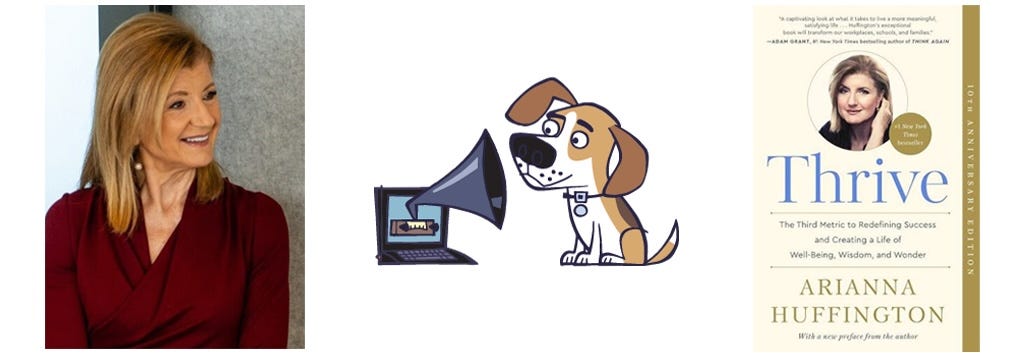
Arianna is a writer, businesswoman, and old friend from the early blog days. She co-founded The Huffington Post in 2005, and after it was acquired by AOL, she became the president and editor-in-chief of The Huffington Post Media Group. She’s currently the CEO of Thrive Global and the author of 15 books, including Thrive and The Sleep Revolution.
A polished transcript is here, including money quotes. Below are timestamps for the main sections of the pod:
5:05: Arianna’s meteoric rise at a young age and challenging left-feminism
28:05: IQ, meritocracy, and what sets humans apart from AI
50:10: A crisis of meaning and the “false god of productivity”
114:07: The importance of sleep and how to improve it
For two clips of the episode — on the desperate need for grace in our discourse, and how to sleep better — head to our YouTube page.
More topics: Arianna’s upbringing in Greece; her dad’s anti-Nazi magazine in WWII; the power of maternal love; her time at the Cambridge Union as its first foreign prez; her first book The Female Woman; her love affair with Bernard Levin; the feminism of the Gospels; meritocracy; AI surpassing us in intelligence; our culture’s distrust of nature; Arianna’s burnout in 2007 and my own in 2015; silent meditation retreats; Matthew Crawford and craftsmanship; Loren Eiseley the anthropologist; mental illness; psychedelics; God as love; Maslow’s pyramid; and Arianna giving me tips for my insomnia.
Browse the Dishcast archive for an episode you might enjoy. Coming up: Emily Eakin on the French postmodernists, Sean Illing on the relevance of Camus and Nietzsche, Jake Weisberg on the cowards who caved to Trump, and Michael Lewis on the bureaucrats who fought back. Please send any guest recs, dissents, and other comments to dish@andrewsullivan.com.
The Genius Of Fauda
From the very first moments of the very first season of Fauda, you believe everything you see. The camera, cannily deployed for immediacy and tension, soon melts from your consciousness and you’re right there: in Ramallah, in Sderot, in pock-marked, trash-strewn streets, and blood-spattered concrete — all heaving in the heat of the Mediterranean. And each member of a fictional version of Unit 217 — an elite special forces unit of the IDF, operating undercover in the occupied territories — is, remarkably, just as credible. The acting disappears.
And then you realize that most of the actors once were in the real IDF — the two co-creators in Unit 217 itself — and you see why it appears so natural. They know exactly whereof they act. On the real October 7, for example, the man playing the lead character, Doron, immediately flew into the danger zone, Sderot, to rescue hostages. Four other cast members returned to duty as well, including the man playing the character of Eli, whose bond with Doron goes back to the very first episodes of the first season and comes to such an intense climax in the fifth. Brothers in reality; brothers on screen; you feel the intensity of the bond.
And so these actors deploy their weapons as if they were extensions of their own bodies, endure torture with staggering equanimity, exhibit near-pathological levels of physical courage — which, because it has so become their second nature, is barely courage at all, just instinct. And having made the action so smooth, they then take the emotional dimension of their characters and create something so unspeakably human it reminds you why Fauda really is one of the great film achievements of this century.
If Fauda did only this, it would be quite something. But the Arab and Muslim characters are no less developed, no less nuanced, and, in some ways, even more physically courageous in their fanaticism than the Jewish ones. In that very first season, we see pain, internal conflict, adultery, lies, betrayal, and atrocities on both sides, until it becomes a too-human blur of sweat-stained mutual trauma.
The staggering beauty of so many of the men, both Jews and Arabs, underlines the poignancy of their mutual extermination efforts. And yet the cycles of revenge grind on, and you see how they make a terrifying emotional sense. The line between good and evil is within every character in Fauda; and it is within both sides. You see Arabs slaughtering innocents; and you see Jews doing it, even those you have come to know and love. Fauda forces you not to look away from either.
When I heard they were tackling October 7 for Season 5, I worried they couldn’t keep it up. I shouldn’t have. Doron begins the season a couple years after that day, clearly broken, truly traumatized this time, hours of his life erased from his memory, trying to recuperate. What he is recovering from — his attempt to rescue a friend’s family in a town overrun by Hamas on that awful day — comes later in a two-episode sequence that could stand alone as a movie in its own right. If you think you know 10/7 and have not seen the actual footage, watch those episodes. If you have a simple, one-sided view of this conflict, watch all five seasons.
The twist in this last season is that one of the worst Hamas genocidaires captured on October 7 — the fanatic who casually machine-guns two kids on a couch before raping and murdering their mother solely because they are Jews — is then recruited by the Shin Bet as an informer. The logic of total evil beckons total shamelessness to counter it. And the show refuses to let you off this hook. You see the truly, truly hard choices the Israelis have to make, choices most of us in the West mercifully have no inkling of, and the moral consequences. In Fauda, as in reality, all its saints are sinners; and all its heroes are required to become monsters in the end.
And yet, you want Doron to win. You want the Israelis to prevail. Of course you do. For all the moral complexity, there is something so truly evil about the Hamas cult, so nihilist, so fanatically brutal, it disqualifies itself from any sane support. So many of its leaders are frightened boys, emotionally immature, caught in cocoons of theological madness, or traumatized into evil from childhood — and Fauda shows it all. You never lose sight of the core and deep injustice that Israel’s founding represents for so many; you feel the pain of that dispossession. But you also see how utterly understandable bitterness has deepened into something much darker, a religious hallucination that has become indistinguishable from Nazi-style antisemitism.
Throughout the show, you see human eyes: dark, brown, terrified, inscrutable, deceptive, aflame, deadened. But you are left in the final moments looking at the back of Doron’s head as he washes his hands and forearms in a sink and looks at the mirror. It’s an image that has stuck with me since. For me, this extraordinary man has become a symbol of Israel, its staggering nerve, its righteous passion, and its tragic, traumatized unraveling. And what we know of him is what we really don’t know about Israel’s mortal enemies: ultimately, he wants to retire to his vineyards; he wants a peaceful life; he never wanted to become the killing machine he has become.
But a killing machine he now is. Waiting to be called back to duty.
The View From Your Window

Bled, Slovenia, 8.12 am
Money Quotes For The Week
“Alito and Thomas are basically MAGA hacks at this point, right? The administration’s position in the mail-in ballots case is absurd,” - Richard Hanania. Yep. This case should have the scales fall from all our eyes.
“18% job approval for Trump among 18-29 young people. I’ve never seen a number this low for any president among the young,” - Larry Sabato.
“You need gold to buy diesel now, so maybe it is ‘the Golden Age’,” - Thomas Massie.
“Sen. Mitch McConnell is back — but is he really?” - Troy Farah.
“We want to go to the past,” - Gonzalo Fernández de Heredia, 22, an engineering student and a budding member of the young Spanish right.
“Maybe you’ve seen the cartoon where you have a fish climb a tree? Well you don’t assess a fish on climbing a tree because fish can’t climb trees,” - Felicia Thomas-Williams, a member of the New York State Board of Regents, on why they are ending basic tests of reading and math for students to graduate from high school.
“I have long since decided that if you wait for the perfect time to write, you’ll never write. There is no time that isn’t flawed somehow,” - Margaret Atwood.
Mental Health Break
A music video with Book of Mormon vibes:
In The ‘Stacks
Josiah Waters details the grave implications of the Fed hike.
A rare issue uniting red and blue: fear over AI.
But how would AI fund the apocalypse? Matt Yglesias has “a simple plan to save the world.”
Noah Smith covers the racist flashpoint over a UT-Austin photo.
Nathan Cofnas debates Charles Murray: “For once Murray defends the less controversial position.”
Are the school bans on smartphones working?
Noah Carl observes, “Wealth doesn’t have much effect on school performance.”
Ed West reviews James Marriott’s new book about our post-literate society.
Leah Libresco Sargeant asks, “What do we owe the embryos we leave behind?
Looking back at the genius of Norm MacDonald.
Much ado about masturbation.
The View From Your Window Contest

Where do you think it’s located? Email your guess to contest@andrewsullivan.com. Please put the location — city first, then country — in the subject line. Proximity counts if no one gets the exact spot. Bonus points for fun facts and stories. The deadline for entries is Wednesday at 11.59 pm (PST). The winner gets the choice of a VFYW photo book or a two-year Dish subscription. If you’re not a paid subscriber, please indicate that in your entry and we will give you a free month subscription. Happy sleuthing!
Next up, a dissent over last week’s announcement of the Dish going in a new direction for a while:
Given your move to prioritizing the podcast over the weekly column, I’m going to unsubscribe for now. Podcasts don’t fit into my routine, and I’m already over-subscribed in that area. I’m defending my time outside walking and hiking, as I want that free to clear my head and take in my surroundings and be with my dogs — and that seems to be the only good time to listen to podcasts for me.
So for now, I’m out. Big fan, and wishing you the best with your memoir.
Give us a few weeks before bailing, will you? I’m not stopping writing, as you can see from today. I just won’t be doing the heavy lift for a full column. And the podcast transcripts can be read.
Here’s a subscriber sticking with us:
I fully understand your frustration and look forward to your new emphasis for the Dish. I realize that as president, Trump is newsworthy — but the best way to handle a babbling idiot is to ignore him. OK, that’s not possible with Trump, but why not just make a brief reference to his comments, mock them, and go on to more important issues. He will simply be remembered as the worst president we ever elected.
Yep. I won’t let atrocities go unnoticed. He may try something truly hideous in November. But I’m re-balancing away from politics for a year or so.
Someone who just re-subscribed:
I’ve been a Dishhead forever, going waaay back. I let my subscription lapse a year ago. Why? Because there was just so much you or anyone else could possibly say about this freak show of a presidency! But I’ve just re-upped as a paying member, and I so look forward to the new output.
Awesome, thanks so much! More feedback on the new Dish is below, but first, some commentary on the classic episodes we re-aired during the August break. A listener writes:
After letting my subscription lapse last year, I just resubscribed and wanted to tell you why. First, it was NOT because you talked about transgender and gender fluidity issues involving children. In fact, that is exactly why I subscribed a few years ago. Your questioning and courage helped me immensely as a member of my family was going through those issues.
No, I had let it lapse because I felt the quality of interviews had deteriorated a bit, and because I now refuse to read or listen to anything involving Trump. But I have resubscribed because I listened again to the Glenn Loury and Louise Perry episodes and remembered that when this show is good, it’s the best podcast there is, and very important.
So keep at it and I’ll keep subscribing!
More on the Perry pod:
Thank you SO SO much for rebroadcasting this episode with Louise Perry. (I missed it previously.) It was THE BEST discussion of an incredibly difficult issue that I have ever heard.


