


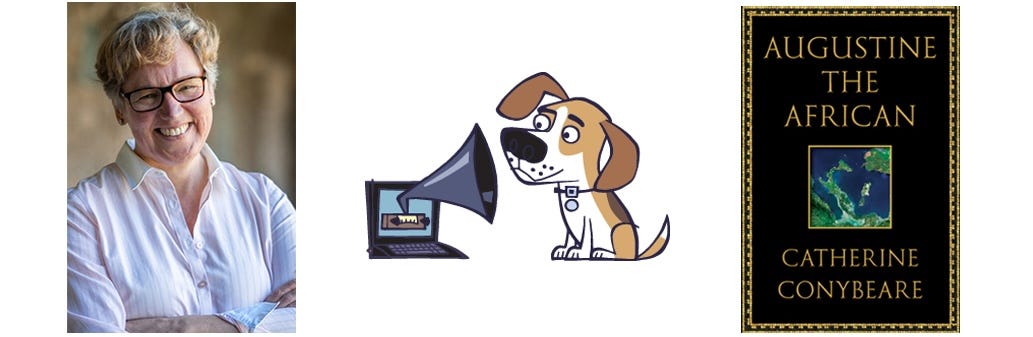
Catherine is a philologist with a particular focus on Augustine of Hippo. She’s both the Leslie Clark Professor in the Humanities and a Professor of Greek, Latin, and Classical Studies at Bryn Mawr College. The author of many books, her most recent is Augustine the African. We had an exhilarating afternoon talking about this African who helped frame the West.
The episode was recorded on October 27, 2026, and aired on October 30. A polished transcript is below. Timestamps for the main sections:
07:43: How Catherine came to specialize in Augustine
24:19: The profound influence of his mother
42:56: His conversion to Christianity
52:42: The deaths of his mom, son, and best friend in quick succession
101:23: His decades preaching and writing in Hippo
For two audio clips — on Augustine’s struggles with sex, and the moment he converted to Christianity — go here and here on YouTube.
More topics covered: Catherine growing up mostly in Oxford; her family’s dedication to the classics; the Romans’ Gaza-like destruction of Carthage; the ferocious debating style of Augustine; his struggle to be humble; his emotional openness; his disgust over Roman games and executions; his early interest in Manichaeism; the problem of evil; sex in the Garden of Eden; Augustine’s persistent horniness; his 14-year relationship with a woman he ditched for an arranged marriage; his close bond with his Christian mother who long tried to convert him; the unprecedented nature of his Confessions; Oakeshott’s awe; Augustine on friendship; memory and time; The City of God filled with relentless counter arguments; Wittgenstein and the limits of language; the miracles of everyday life; the homelessness of Jesus and St Francis; and how Rome was falling at the end of Augustine’s life.
Money quotes from Catherine:
“It is an absolute mystery how Augustine managed to produce so much [five million words that survived]. So he would have preached pretty much every day. … Pretty much every day, people would come to him with problems, with things that needed judging, resolving.”
“He thinks questioning is healthy. He wants to carry on, and his relationship to the divine is asymptotic. He knows he can carry on and on and on asking questions, and it will get him closer to the divine, but it will never quite get him there.”
On his conversion to Christianity: “This incredibly complicated quest for simplicity is, in some ways, the story of the Confessions, and frankly, in some ways, the story of Augustine’s life more broadly. I think he struggled with becoming a child in this way. I think he struggled to achieve the humility he needed, but he knew he needed to carry on trying.”
“The thing I found extraordinary when I started reading Augustine’s sermons in detail, is though the language is incredibly simple, the concepts are not. He’s not talking down to people; he’s talking simply, but he is explaining quite complex theological ideas.”
“I love his appreciation of the miraculous in the everyday. … He basically says that people make such a big deal of how Christ could be God and man both at the same time. And they don’t stop to consider the absolute miracle that every single day, new humans are made with both soul and body completely combined in a single person. That’s a miracle too.”
Browse the Dishcast archive for episodes you might enjoy.
Full Transcript
Andrew: Hi, there. Welcome to another Dishcast. It’s a beautiful, beautiful fall in Washington, DC. I want to thank you for subscribing, first of all. If you haven’t subscribed, please do. We have no ads. We have no sponsors. It’s just you, me, and a guest. That simplicity is entirely dependent upon your generosity, so please subscribe. If you haven’t, this conversation will be badly truncated in ways that will frustrate you deeply. So get ahead of it and subscribe now.
We have some amazing guests coming up. We have Cyrus Habib who’s coming in talking about how he left politics to become a Jesuit priest. Peter J. Williams on why the gospels are probably more accurate than you might imagine. Graham Tomlin is coming in to speak about Pascal and Nancy Sherman is coming on to talk about Aristotle. Big deep themes, as promised, but we also have Michael Barone coming on to talk about the midterms. We will go over it in great detail. We have Francis Fukuyama coming in to talk about his memoir and The End of History and what’s happening in the world. And Hamish McKenzie, one of the founders of Substack, good friend of the Dish, he’s coming in to talk about what’s happened to journalism and why Substack matters.
But this week, a subject that’s always been dear to my heart. And to be honest with you, one of the impulses is I’m working on this memoir, as you know, and why not read the OG spiritual memoir — the spiritual memoir that really defined the genre. And it turns out, of course, I’m talking about Augustine’s Confessions. Well, there’s a new book, and my guest today is Catherine Conybeare, and she’s a philologist with a particular focus on Augustine of Hippo. (Hippo was the bishopric of where Augustine presided.) She’s both the Leslie Clark Professor in the Humanities and a Professor of Greek, Latin and Classical studies at Bryn Mawr College.
She’s the author of many books, but this one, which we’ll talk about, looks at Augustine from a fresh angle: the African thinking of him, as someone who really should be thought of as someone from the north coast of Africa looking at the Roman Empire as opposed to the Roman Empire looking from Rome out to the provinces. And the book actually has this lovely map of the Mediterranean, but upside down. So you just begin to see how really the Mediterranean was not quite what we think it is. And we tend to ignore the entire Roman civilization south of the Mediterranean. We don’t think of it, but that was crucial, critically important, more important, way more important than much of what was going on up north.
Anyway, Catherine, thank you so much for coming.
Catherine: Thank you so much for having me, Andrew. It’s such a pleasure to be here.
Andrew: Tell me where you grew up and who were your parents; what did they do?
Catherine: I had a peripatetic childhood, but the core of it was actually spent in Oxford. We moved there when I was 6 and away when I was 13. And the reason for the wandering is that my father was an orthopedic surgeon and he was moving up the ranks of surgical practice. And he actually got his final job in Canterbury. So that’s where they settled in the end and that’s where my parents still are.
Andrew: And what brought you into the idea of studying ancient languages? It’s not something that the average schoolgirl would think of doing. So what was it that first piqued your interest in this whole area?
Catherine: This is a strange question to have to answer honestly. I was brought up in a very intellectually old-fashioned household that held that if you were bright, the highest possible achievement would be to read classics at Oxford. That’s what my grandfather did.
He was, I think, rather idolized by my grandmother — who incidentally also had a degree from Oxford — and my mother, who also had a degree from Oxford, but he was held up as the model, and that was what I was expected to do. So though I actually loved the study of Latin and Greek and their literature and philosophy, I was also channeled towards it in very particular ways. And in some ways, my entire career has been rethinking that challenging, but from the very strong base of a superb training in Latin and Greek, which I got from high school onwards.
Andrew: High-school Latin and Greek.
Catherine: Greek at a grammar school in Canterbury. When I was 14, I started Greek and that was remarkable. Then, I changed school for the last two years to continue studying Greek.
Andrew: So were you more a Greek scholar than a Latin scholar?
Catherine: Yes. When I left Oxford, I would say my Greek was actually better than my Latin, but I had become fascinated by late antique and medieval Latin, and specifically by what happened to the Latin language and the classical tropes and genres when Christianity hit it. Well, that’s how I configured it at the time. I was so intrigued by the new energy that Christianity brought to what I had come to feel was rather tired, rather etiolated literary production.
Andrew: Because I think people sort of don’t realize or don’t always fully grok that Christianity was a late entrance into Roman, certainly the Greek civilization, but Roman civilization as well. So how did it change philology? How did it change language? Was it a way in which they used different words, or was it they transformed the kind of tropes that they would use or was it just the energy behind it?
Catherine: All of that. So yes, certainly the scope of certain words change. Once you’re developing a vocabulary for Christianity, to some degree you’re building on the pre-existing vocabulary. A really simple example: pater, or father, no longer necessarily means just your biological father. It can also mean the Father in heaven. Caelum — heaven or sky in classical Latin — starts to have this composite meaning in Christianity, more like what we mean by heaven today.
Andrew: So you start to get these double meanings and this greater emphasis.
Catherine: Exactly.
Andrew: And it’s in that context that this character shows up. And when did you first stumble across Augustine in your work?
Catherine: I backed into the study of Augustine.
Andrew: It’s always a good way to do it.
Catherine: Because he’s terrifying, because it’s such a vast oeuvre; there are five million words, five million words of his writing that survive.
Andrew: That’s incredible.
Catherine: And then, there’s vast amounts of scholarship on him and you can start that scholarship where you like. I mean, you can start it with Petrarch if you like. So, a huge scholarly production, and nothing from my undergraduate degree had prepared me to work on him, so I avoided him. But I began working on a doctoral dissertation on one of his contemporaries, on the letter collection of one of his contemporaries, a man called Paulinus of Nola. And I discovered that the only letters for which the response survived was the correspondence with Augustine.
And at that stage, actually, I had a baby, and while the baby slept, I sat down and I read all of Augustine’s letters. So that was my way into him. It wasn’t through the Confessions; it wasn’t through The City of God. It was this very diverse, personal, large corpus of letters that’s getting on for 400 of these letters.
Andrew: With this particular person?
Catherine: No, no. This is the whole of — I read all of Augustine’s letters.
Andrew: Wow.
Catherine: There’s only a handful with this particular person, but I became fascinated, so I expanded out from there.
Andrew: Well, let’s put him in some context to start with. Who is this person and when was he born and what was the world like when he entered into consciousness?
Catherine: So he was born in the middle of the 4th century, 354 CE, and he was the son of a small landowner and town counselor in Roman North Africa. He was born in a place called Tagaste, which is now Souk Ahras in modern Algeria. It’s about 80 or 90 kilometers inland from the coast of Algeria. A relatively small, humble, Romanized town in the foothills of the Atlas mountains, quite a rough, scrubby, olive-growing region, but on the edge of an extraordinarily fertile region of North Africa. North Africa, at that stage, was ruled by the Romans all the way from the west coast of modern Morocco, all across Algeria, modern Tunisia, Libya, and Egypt and of course, then on around the eastern side of the Mediterranean.
Andrew: How long they’d been occupying it?
Catherine: Well, they obliterated Carthage, that age-old enemy, in 146 BCE.
Andrew: And when we say obliterated, they did a Gaza basically. When I think of Gaza, I think of Carthage in terms of they just obliterated it.
Catherine: Interesting. Yes. I mean, that makes it very real, and that is essentially what happened. The Romans had been fighting the Carthaginians for many years and they wanted to make Carthage uninhabitable. But 150 years later, the Emperor Augustus resettled it and it became, again, a powerful thriving city, a major center of education and culture, a major center of trade.
Andrew: But a Roman city?
Catherine: But a Roman city, precisely.
Andrew: So when Augustine grew up, would he think of himself as a Roman or as an inhabitant of Tagaste or as a North African or as an African? What would he have learned to be his identity as he grew up?
Catherine: This, of course, is the fundamental question for a book called Augustine the African. He would certainly have thought of himself as Roman. He was acculturated to be Roman. His native language was Latin and he learned the same Latin texts as any young boy anywhere else in the empire. But at the same time, he quite clearly had a strong sense of himself, as from that particular region. There are places where he seems to identify with African as a category, which does exist in Latin.
Andrew: Yeah, Africanis. So when he meant Africa, he would mean North Africa essentially.
Catherine: Precisely. He would mean the geographical region that I just outlined. But in general, identities were more regional than that. So I think he very closely identified with that corner, sort of eastern corner of Numidia, western edge of what was called Africa Proconsularis. So it’s very local.
Andrew: Sort of near Tunisia today.
Catherine: Exactly.
Andrew: And he would’ve spoken Latin?
Catherine: He would’ve spoken Latin, yes.
Andrew: But Punic was also a language that was spoken then. Obviously, that must have been stigmatized after the Punic Wars, as we call them.
Catherine: Well, don’t forget it’s we who call them that. Punic.
Andrew: Right, yes, I’m sorry, yeah.
Catherine: I don’t know whether it was stigmatized. It persisted in amazing ways. In general, regional languages collapsed under the Roman Empire, under the pressure of Latin. North Africa defiantly preserved its languages —not just Punic, but Berber and some other local languages of which we have no trace, but only references. So people around Augustine would have been speaking Punic. His nurses may have spoken Punic. We know he refers to them that he had nurses, but he doesn’t seem to have learned the language. He seems to be pretty monoglot.
Andrew: And he hates Greek.
Catherine: And he hated Greek.
Andrew: I just love that. I mean, there are many people who lived at this time and we know lots about them, but we don’t know that they hated Greek. But this is why he’s a one-off really, why he sort of springs out of somewhere very different. I mean, no one’s like him.
Catherine: Exactly. He’s so emotionally open. I think that’s part of what makes him feel so modern. But the remarkable thing about him also is he doesn’t just say, “Oh, I hate Greek. Oh, it was so hard.” What that leads him into is a reflection on how difficult it is to learn a second language and how even if you love what that second language can give you access to, so he loved stories. He would’ve loved to read Homer, but he never became comfortable with Greek. And that was a source of embarrassment to him, but it also opened the door to him thinking about language and the different things that languages could do.
Andrew: You see him, all the time, he’s just always asking the second question, right?
Catherine: Exactly.
Andrew: He’s not just saying, “I hate Greek”; it’s like, “Why do I hate? Why is that interesting?” He subjects the experience of everyday life to a series of unending sort of questions. He’s obviously, from the very beginning, super curious about the world.
Now, the first thing that he sort of really gloms onto, which I never really fully understood, and I’m not sure I still understand it, Manicheism that is this very popular at the time, a doctrine about the world. I mean, obviously let’s not get lost in Manicheism, but if you could sum it up in a couple of sentences. We think of it, I think, as this splitting of the world into two, good and evil, these two forces that exist that are constantly at battle with each other. And obviously, that’s not compatible with what Christianity says. Why was it popular, and what did it actually argue?
Catherine: It’s quite right to think that it was essentially dualist, divides the world into dark and light, evil and good. And the point is that they’re not just forces; they’re actually material objects. There are seeds of light entrapped in dark matter in the world. And the object of Manicheans is to release those seeds of light so that ultimately the forces of light will prevail.
Now, this is extraordinary, obviously. Why Manicheism attracted Augustine was because he had become preoccupied with the problem of evil in the world, and he thought that Manicheism would provide an answer to that. It also had a creation story that he found appealing, but above all, he liked the notion initially that we could attribute evil to actual dark matter in the world.
Andrew: Yet there’s this belief that a sort of materialism, that there’s nothing other than matter.
Catherine: Exactly. Yes.
Andrew: Which of course is very alien to the Christian. Where did this come from? Was there an original thinker?
Catherine: Yes. The original thinker was called Mani. He grew up in the 3rd century in what’s now Iran, and Manicheism was incredibly successful, I think, partly because of this rather simplistic answer to something that bothered people who thought about the world, but partly because wherever it went, it went in the disguise of the local religion. So Manicheans in Augustine’s area of North Africa just called themselves Christians or True Christians, and they had Christ as part of their worldview. So it looks a bit like Christianity. When they moved towards China, they incorporated Buddha. They had Buddha as part of their worldview. So it’s a chameleon religion, but it does have, at its base, this fundamental, as you say, materialist dualism.
Andrew: At the same time, we know from the Confessions that Augustine was obsessed with the physical world. I know that we might as well get it over with, but I mean, the one thing that strikes you really in the Confessions, this man had a real — he’s both very sexually active and extremely sexually ambivalent about it, right? I mean, am I getting this right? We have the famous moment where he’s embarrassed or kind of embarrassed by his dad in the baths. He obviously gets a boner of some kind or I don’t know what happened, but he’s kind of ashamed of it. His dad is proud.
Catherine: I think he’s mortified because his father rushes home and says, “Look, we’re going to have grandchildren.” He’s like 14 at the time. So I think it’s as simple as that.
Andrew: Really? It was just like, “Oh shit, this is happening to me.”
Catherine: Exactly.
Andrew: But then, there’s a sense that this is, obviously, something that drags you down into filth and muck and animalistic stuff. But despite that feeling, he’s in a relationship, an actual relationship with someone whose name we don’t know, for 14 years. How should we put it? He’s bedding this young woman and they seem to have a really — actually, this is not a completely utilitarian; there was a real affection and love between them. So how common was that in those days? He wasn’t married, but he had a live-in partner.
Catherine: That’s a whole stack of questions.
Andrew: I know, I know, I know. Sorry.
Catherine: So to start with the body, don’t forget that he’s writing the Confessions from which we know about all this when he’s just been ordained as a bishop. There’s all sorts of reasons now to distance himself from sex.
Andrew: Okay.
Catherine: And indeed, I don’t know whether you’ve noticed this, it goes by quite fast, but in book 10 of the Confessions, he’s talking about the different ways in which he can still be tempted. And there’s an elegiac passage about music and how much he still loves music, and he listens to the Psalms, and he starts concentrating on the music instead of the words. But in the course of that, he acknowledges he still has wet dreams. So he is still very much a sexual being, but he also needs, to some degree, to distance himself from that because he has committed himself to celibacy.
He actually didn’t have to. At this stage in Christian development, bishops could be married. But he had come to feel that sex was really a distraction from what he should be doing as a dedicated Christian, which gets us back to your question about this long and apparently devoted relationship. I would guess he may have slept around a bit when he was in his mid-teens, but he was with this woman by the time he was about 17 and stayed with her until his early 30s.
They had a son together. And I agree with you; I think there’s every reason to suppose that he was devoted to her. I personally think that one of the reasons we don’t know her name is because when they separated, she would have gone back to their hometown and everyone who was reading the first draft of the Confessions would have known exactly who she was, and he’s giving her a bit of protection, a bit of privacy having had this, if he’s to believe, a terrible breakup. At least he doesn’t have to drag her through it all over again for centuries.
Andrew: And he broke it off because it was time for him to get married, and they found this much younger [woman], which he was okay with. But she wasn’t old enough yet, so there was two more years to wait before he could start over, as it were.
Catherine: Right. And he took another lover in that period, he tells us. But you asked whether it was normal to have a long relationship outside of marriage. Yes, it was. That was something that conferred legitimate legal status. It wasn’t the same as marriage, but it was a formal and formally recognized relationship.
Andrew: Domestic partnership.
Catherine: Domestic partnership.
Andrew: There’s so much here that is contemporary in ways. And then, his mom and dad who are — we really don’t know much about his father, right? He’s a Roman.
Catherine: Right.
Andrew: His mother, we know a hell of a lot about. He was a mama’s boy. He was devoted to his mother, and the passages in the Confessions about her are among the most moving ever written about a mother, because he’s aware of how much he pained her, how much distress he caused her because she too — well, she, unlike him at the time, had had a full-blown conversion to Christianity. Tell us about Monica, that’s her name — Saint Monica, we Catholics are obliged to call her. She clearly had her own mind and had a serious faith that she tried endlessly to get her son to appreciate. Tell us a little about her.
Catherine: “Monica” is a Berber or Amazigh name, so it’s thought that she was herself, Amazigh. So she is a native North African. His father may have been too. We just don’t know. And you’re right; she was a force, and we see that actually not so much in the Confessions as in some works that were written while she was still alive. He wrote a set of philosophical dialogues in which she actually plays a role, and you can see she is down to earth. She’s no-nonsense, but she’s also really quite smart.
She has, or at least he portrays her as having, the art of getting to the heart of things, and I think we see that going on in the Confessions too, which was written after her death. And indeed, her death is described very movingly in the Confessions. You wouldn’t know from the Confessions that Augustine had a brother. He really is a mama’s boy. It’s like Proust writing his brother out of the narrative. It’s all about her trying to lead him to Christianity.
When he comes across the great Bishop Ambrose in Milan, the person who ultimately is responsible for his conversion and who baptizes him, Ambrose doesn’t give Augustine the time of day, but he’s really impressed with Monica, and he tells Augustine how lucky he is to have a mother like that.
Andrew: Right. And she’s there forever as this incredibly powerful superego, really. I mean telling him the right thing to do, and he reveres her for that in the end. Right? I mean, but he loved her before that. He loved her when they were at odds.
Catherine: I think he did. And again, one has to make allowances for the retrojection for the fact that he’s looking back. But I think she was an extraordinary presence in his life. I think these writings while she was alive were true. There’s a wonderful moment much later on, decades after she died, when he says he’s writing actually to my man, Paulinus of Nola, about the care of the dead, and he says, “I know for sure people don’t come back from the beyond, because if they did, my mother would be there every night.”
Andrew: Yes. She would never let go of him.
Catherine: Right.
Andrew: She loved him also quite passionately.
Catherine: Exactly.
Andrew: She followed him to Italy. She picked herself up and went all the way to Milan and Rome, right?
Catherine: Yeah, which is astonishing if you think about it. Now, one of the reasons I wanted that map put on the front [of my book], first, as you already alluded, north and south are inverted; but second, it shows how close North Africa — and specifically the promontory on which Carthage sits — how close it is to Sicily and to Italy. It actually projects up above the level of Sicily, or below if you’re looking at it that way up.
But nonetheless, this was a huge journey for a small-town girl. She took it, if he is to be believed, on her own — or, if not on her own, with, as it were, subordinate members of the family who she was leading. And she pursued him, first to Rome and then to, as you said, Milan.
Andrew: Was this after he’d converted or before?
Catherine: No, before. At the stage that Augustine went from —
Andrew: So she was still trying to push him.
Catherine: Exactly. No, at the stage that he went from —
Andrew: She was on his case.
Catherine: Sorry?
Andrew: She was on his case.
Catherine: She was on his case, yeah. She wasn’t letting him go. No, at the stage he went from North Africa, specifically from Carthage, modern Tunis, to Italy. He was still an ambitious young man making his way in the world actually, through his skills in Latin, through his skills in rhetoric, and he ended up with a post at the imperial court. That’s why he was in Milan, because the imperial court was in Milan at the time.
Andrew: So let’s talk about his talent, because he became known because he was a very good speaker. I mean, that’s primarily it, right? I mean, he gave talks.
Catherine: Exactly.
Andrew: So what was he giving talks about?
Catherine: He may have hated Greek, but he was spectacularly gifted in Latin. He was teaching. He was teaching other young men rhetoric. I suspect philosophy as well, given those philosophical dialogues, and he would have been giving show speeches once he was at the imperial court. It was his job to produce speeches in praise of the emperor, formal speeches. He carried on teaching there as well. And for ambitious young provincial Romans, skill in rhetoric was the passport to a better life, to a higher social class, and to more money.
Andrew: So this young man is on the make, and he’s succeeding with his own talents and skills. But then he starts reading Platonists, and he begins to move towards an idea that things can exist in an entirely spiritual zone as opposed to — in other words, his materialism begins to waver, or begins to be challenged.
Catherine: Yes. It was clearly a huge moment for him when he really immersed in the works of Plato, and the Neoplatonists writing much more recently to Augustine’s time. In particular, I think the works of Plotinus, because he finally understood how something divine could be purely spiritual. And once he had internalized that belief, then his days as a Manichaean were numbered, because there was no place for a truly spiritual belief in a Manichaean world system.
Andrew: What strikes me is that he’s genuinely trying to figure out the truth of the world. That’s what he’s doing.
Catherine: Exactly. Yeah.
Andrew: And you find this in the Confessions, which is sort of — forgive me, it’s the work I’m most familiar with — but he will talk about why he believed such a thing and why he came not to believe it, and then what were his motives in not believing. I mean, he’s amazingly able to turn over everything that is going on in his fertile brain, but it’s all driven by the desire for something bigger, the ultimate truth of the world.
Catherine: Yes. I love that you refer to his fertile brain. I think that’s exactly right, and he is always thinking and always questioning, and I’ve been talking about framing the Confessions in the moment in which they were written, but that impulse to question and to search and to ask the next question again continues throughout his life in The City of God, his other best-known works. It can actually be quite hard to read, because he’s so aware all the time of counterarguments.
So in the Latin, at any rate, you get these enormous branching sentences where he starts off with two possibilities, and then he realizes that actually one of them can be subdivided, if people ask the opposite questions, and then the other one can be too. And so it goes, and the next thing you know, this sentence has lasted half a page and branched across all these different possibilities of interrogation. It’s fascinating.
Andrew: And he’s almost obsessed with not letting any open question go unresolved. So in the last part of his life, when he’s furiously denouncing Pelagianism, he’s engaged in a final sort of — he is manic. And again, these arguments are taking place; this is not blog tweets. This is not competing across the internet, but they are writing stuff that is then read out loud. And every single point that Julian has made, he has to refute, and then Julian comes back and refutes every single thing he did, and he goes back, and it goes on forever and ever. It’s like an LLM, this thing.
Catherine: That’s right, and it is large, and it only stops with Augustine’s death.
Andrew: Right.
Catherine: Yes, we could refer to it as pamphlet warfare, except that these pamphlets are the size of bricks. They’re enormous the way they go to and fro, and Augustine does try to refute every single point. That’s because he really does think not just Julian’s immortal life is on the line, but everyone who’s convinced by Julian — sorry, Julian being his principal opponent in this anti-Pelagian warfare. The fundamental question about Original Sin and the power of God’s grace is what they’re fighting over. And if I may correct you —
Andrew: Please.
Catherine: You said earlier, Augustine likes to have things closed down. He likes an answer. I actually disagree with that. In general, he doesn’t. He thinks questioning is healthy. He wants to carry on, and his relationship to the divine is asymptotic. He knows he can carry on and on and on asking questions, and it will get him closer to the divine, but it will never quite get him there.
But for the anti-Pelagianism battle, you’re absolutely right. He thinks this is truly a matter of life and death, and he does want to close off possibilities. That, I would say, is atypical.
Andrew: For him?
Catherine: For him, yes. Not for most people.
Andrew: No, I misspoke. I think he just was never satisfied with an answer, needed to penetrate further and further.
Catherine: Yes.
Andrew: That’s sort of what I mean, and there’s no point at which he’s like, “Okay. That’s it for the day.”
Catherine: No.
Andrew: And I try to imagine, let’s think of him in his later part of life when he’s converted, he’s preaching. What was his day like? He must have spent hours just writing and thinking. I mean, he was a public intellectual, really.
Catherine: It is an absolute mystery how he managed to produce so much. So he would have preached pretty much every day. He would have held what they call audientia episcopalis, a bishop’s audience. Pretty much every day, people would come to him with problems, with things that needed judging, resolving. That’s part of his job. He would have had to move among his parishes, checking up on people. He maintained a vigorous correspondence, and he wrote these enormous works.
The City of God is in 22 books. On the Trinity is in 15 books. Confessions is in 13 books, and those actually pale into insignificance compared with what he composed against the Manichaeans and against the Pelagians and against the local North African church, all of which were polemical and somewhat repetitive, has to be said, treatises.
Most of his writing — notwithstanding those iconic Botticelli images where he always has a book in one hand and a pen in the other — and he can’t even stop writing to have his portrait taken. He would mostly have dictated what he wrote. But even so, there he is in his monastery with monks around him taking dictation.
Andrew: To me, it’s even more extraordinary that he did —
Catherine: Where did he find the energy, and how did he keep his train of thought?
Andrew: Right. We lose our train of thought here in a podcast, right? He’s doing this for hours and hours and days and days and months, years and years and years.
Catherine: Exactly. And he’s composing major books alongside each other. De Trinitate — sorry, On the Trinity — and The City of God are composed over the same span of time. They’re complementary works. They’re both unbelievably complex, ambitious works. How did he do it?
Andrew: I don’t know. How did he do it? You tell me. He was a genius of some kind, some strange genius.
Catherine: And genius is such a overused and imprecise word, but yes, I would use it of Augustine for that intellectual energy, for that originality, for precisely the way he kept his train of thought — whether it was in battle or in constructive theology, in creating ideas that we’re still living and working with.
Andrew: Yup. And the other thing that strikes me that you might not think of a saint doing — he is brutal. He is lacerating, snarky. He can be vicious.


