


(The full Dish returns on September 4. In the meantime, we are re-airing a handful of the most downloaded episodes from the early years of the Dishcast.)
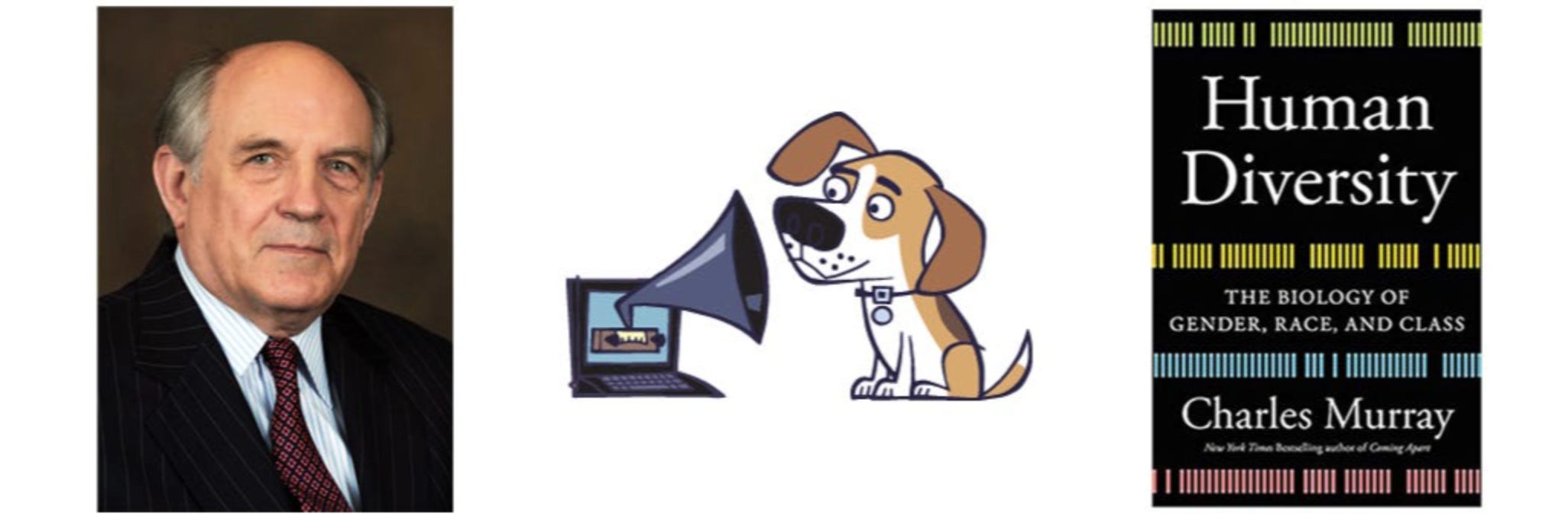
Charles is a writer, social scientist, and longtime friend. He currently holds the F.A. Hayek Chair Emeritus in Cultural Studies at AIE, and his many books include Losing Ground, The Bell Curve (co-authored with Richard Herrnstein), Coming Apart, Facing Reality, and Taking Religion Seriously (which we covered last year). In this May 2021 pod, he and I discussed Human Diversity — a book that received little attention compared to the others. If you think you know who Charles is from the way the MSM has portrayed him for years, this conversation may surprise you.
Like Cornel West, Charles is a one-off: absurdly brave (or dumb) in wading into truly touchy subjects, and always with reason. In many ways, I think if we’d been able to have a serious debate about The Bell Curve all those years ago — and I tried to encourage one — we might have avoided some awful subsequent mistakes. But we resorted to abuse and hysteria and went on to enact Woke 1.0 and, now, Woke 2.0.
Go here for a polished transcript of Charles. We also have three clips on YouTube: on the different career choices of high IQ women; the “unearned gift” of a high IQ; and IQ’s irrelevance to the human worth, dignity, and essential equality of all people.
Below are many of the listener emails we posted after the pod aired. One quick take:
Great to hear Charles Murray! I’m sure Twitter subsequently lost its mind — good. Screw ‘em. Has anyone been more unfairly maligned than this man?
Twitter was oddly quiet, actually. Another fan of the episode:
Oh jeez, Andrew — I can imagine the fun mail you’ll be getting for this one, but it’s the episode I’ve been really looking forward to! I found it both insightful and emotional.
What sticks out for me is the section about affirmative action. When Murray says that when he went to Harvard in 1961 there were few Blacks, and that you KNEW they absolutely deserved to be there on merit and academic acumen, that rang true. But then … there was no acknowledgement by him or you of the obverse: many of the white kids were there because of legacy or rich parents. I mean, isn’t that how Bush 43 ended up at Yale? There MUST be a recognition of that when talking about affirmative action.
Absolutely. I don’t want to end affirmative action before ending legacy admissions. They are inextricable acts of unfairness — but the long history of legacy discrimination makes it a higher priority. Here’s a dissent:
I find all this talk of race and IQ to be rather insulting to folks I dearly love. I would hope you could find a guest similar to Stephen Jay Gould (who’s dead) to provide a useful counterpoint to Charles Murray. Robert Bieder is still alive; he’s 82, and his book Science Encounters the Indian is a wonderful overview of the racist anthropology of the 19th century. If you’re going to give time to Murray, then you owe it to your listeners to give time to the scholars who helped us all understand that intelligence has nothing to do with the melanin content of a person’s skin or how they do on a test.
Obviously intelligence has nothing to do with melanin. But it is measurable, and real, and denial of this seems to me to be a denial of science. Another dissent:
First, I’ll lead with my background, which informs my thoughts on this: I was brought up by my Ashkenazi Jewish mother with a Yoruba/Nigerian father by blood (though not culturally). I’m in an odd space in the race wars.
The motivated reasoning on race and intelligence by the white community is something I’ve often observed but rarely have seen commented on. For example, somehow the difference between black and white is portrayed as profound, and yet somehow the difference between the Ashkenazi Jewish and Gentile communities is portrayed as less profound, even though the gaps are similar: about 1 standard deviation between each set of groups.
Also, in the case of the Jewish community, which has a lopsided verbal-loaded performance (visuospatial is below average from the Jewish community), if you just look at verbal ability, it’s likely a >1.5 standard deviation difference. Yet somehow the white community is fixated more on the black community, but doesn’t seem to really address the implications relative to the Jewish community.
More importantly, the discussion of IQ is too unsophisticated. For example, is it possible that “environmental” factors can cause a >1 standard deviation difference in IQ scores? Actually, the answer is “yes”, even obviously so, but due to reasons of motivated reasoning, this is almost never discussed. I refer to the Flynn Effect — a well-documented phenomenon, where psychologists in the industrialized world have noticed that IQ scores have been creeping upwards, to the extent that every 5-10 years they need to “re-center” their scores to keep the average down at 100. As a result, black Americans in 2020 actually get higher raw IQ scores than white Americans did in 1930.
What is the reason that Americans score so much higher today than they did in 1930? Health, education, computers? Who knows, but it’s profound enough that if psychologists didn’t recenter scores, today the average IQ score would be something like >120, which is absurd and can’t be right.
People like you make life harder for people like me. I am a gifted black American who doesn’t need more bigots wearing the cloak of reasoning from the likes of you or Murray. Are there differences between groups? Possibly. Is there bigotry? Certainly. Fighting against bigotry is ultimately more useful. It would be nice if you helped on this matter.
I agree that the white-Ashkenazi gap and the white-Asian gap are weirdly overlooked as well. There was evidence in 2020, for example, of a spike in Asian-American performance on SATs, because recent Asian immigrants — self-selected and CSIS-selected by intelligence over the last couple of decades — have pushed the average up. The same study shows SAT scores diving for everyone else. I wish we had more focus on this than on the white-black gap.
Equally, the Flynn Effect is well-known, but it does seem to have petered out over the last couple of decades — meaning that although IQ scores are indeed higher than they were decades ago, the mean differences among population groups hasn’t changed that much. That’s why they’re busy abolishing SATs — because they cannot do the racial engineering they want if objective reality counts. Get rid of the objective measurements and you can pretend we’re doing something real.
Speaking of Ashkenazi Jews and IQ, Murray back in 2007 wrote a lengthy piece for Commentary on the historical and cultural roots of “Jewish Genius.”
Yet another dissent:
Apparently every time you write about Christianity, I’m triggered — even as I listen to you from the safe space of my morning commute or evening neighborhood stroll. So I disagree with your assertion at the end of your episode with Charles Murray that Christianity provides, as I hear you, an irreplaceable societal value. From afar, it reads a bit more as nostalgia than an argument for something constructive.
I take less issue with your comparison of religion to wokeism than Murray’s to environmentalism, but either way, in what way are any of these secular self-righteous zealots different than the Christian self-righteous zealots marching out front of the Planned Parenthood clinic across the street from my house, their ghastly, spiteful, judgmental signs thrust rather proudly in front of them? While I’d place my divided opinions on that subject alongside your friend Caitlin Flanagan, they are less divided in wanting me to live life under their rules. And if I did, some in my long-time acquaintance would go so far as to feel pride that they’d saved me from myself.
Not only are Christians — and people of every faith — quite capable of a lack of humility that I think you and Murray describe as “that sense of frailty and your own sins,” they’re every bit as capable of perpetrating great evil: Dark Ages, Crusades, pedophilia, politicizing abortion, seeking vengeance through the death penalty, and justifications for abhorrent attitudes toward gay people, et cetera.
A sense of transcendence, of humility, of cosmic insignificance can be a part of faith. But it can also stand alongside. Or be entirely absent.
Referring to a lack of judgement over others, the idea that no one is better or worse than you, you commented to Murray, “I’m so grateful that truth was dinned into me.” Was it dinned into you, or were you born innately receptive to it, even eager to embrace it? You’re likely more educated on this than I am, but I thought it was clear that many of the great social scientists (e.g. Steven Pinker) have dispelled the tabula rasa concept, including of human morality.
That is to say, we cannot possibly fully understand why we are the way we are — and thus whether your intuitions, morality, and thinking are more a product of a Christian upbringing or the same genetic mix as your intellectual gifts. Perhaps your and Murray’s view of a good society simply comes from a natural ability to see complexity, including humanity, rather than from any dogma.
So when you say, “The worry is that they will find other forms of transcendence that mimic religion,” I share your concern — but my concern is about zealotry and illiberalism in all its forms, be it the rabid faith that propels Hamas or far-right Jewish settlers, the savior complex of those abortion protesters marching near my home, or the self-righteousness of any far-left secular nut waving a copy of White Fragility in your face.
For all the demurring on the topic of IQ that Murray does in this segment of the conversation, the obvious irony is that you and he are two intelligent, well-credentialed people having an intelligent, thoughtful conversation about religion. How many Christians are so reflective? Is their Christianity the transcendent factor here? Or is it your ability to see complexity, to simultaneously keep your Christian faith while also dissecting it?
I have long made a distinction between the certainty of fundamentalism and the humility of faith. Christianity is extremely complex, as is religion, and has manifested itself in countless ways, some quite horrific. But Christianity’s insistence that we are “neither Greek nor Jew, neither male or female, but one in Christ Jesus” was radical at the time, and has transformed human consciousness for the better — and away from tribalism.
Charles came back on the Dishcast last year to discuss Taking Religion Seriously, and here’s how one listener responded:
How lucky Charles Murray is to have a friend like you! If not for your promotion of his work through the years, I would only have known about him through his most controversial works — and the widespread criticism of it. I’m embarrassed to say that I probably would have assumed he was a racist, and avoided his work entirely.
But every time you have shared his work, and especially during interviews, I am struck by how curious, thoughtful, and brave he is. Those qualities are essential to do the challenging work he does. I hope that future researchers will use his scholarship as he clearly intends, which is to better mankind’s knowledge of ourselves so that we can find solutions that improve everyone’s future.
Another wrote at the time:
I listened intently to your excellent discussion with Charles Murray — one of your best so far. Both of you were on a journey of discovery, and Murray is so unpretentious and so honest that I could listen to his learning happening as you exchanged observations.
Twice during your exchange, he complimented you honestly, saying, “This is the first interview that has been a real learning experience for me.” The first time was immediately after your explanation of the significance of the Eucharist in Mass (1:15:08). Your comment opened up a new dimension of God’s presence for him, and my thought was that this was a conversion moment for Murray.
One more response came from “an old, Christian, lesbian, law-and-order Democrat (ha ha — what a combo!)”:
The pod with Charles Murray was superb. So rich and meaningful. I so appreciate how open you each were about your faith. I will read Murray’s new book.
And I would (with some withdrawal symptoms) be happy to keep subscribing to the Dish while you step away to finally write your own book on faith. If you can at least keep the podcast going while you do that, that would be fantastic. (When you and Chris took a three-week break a few months ago, I was seriously missing my weekly Dish fix.)
So I say: Take a break from the writing the Dish column and get a move-on. Your new book/memoir — whatever you will call it — will be worth the wait. God bless you and Chris.
See you next Friday.


