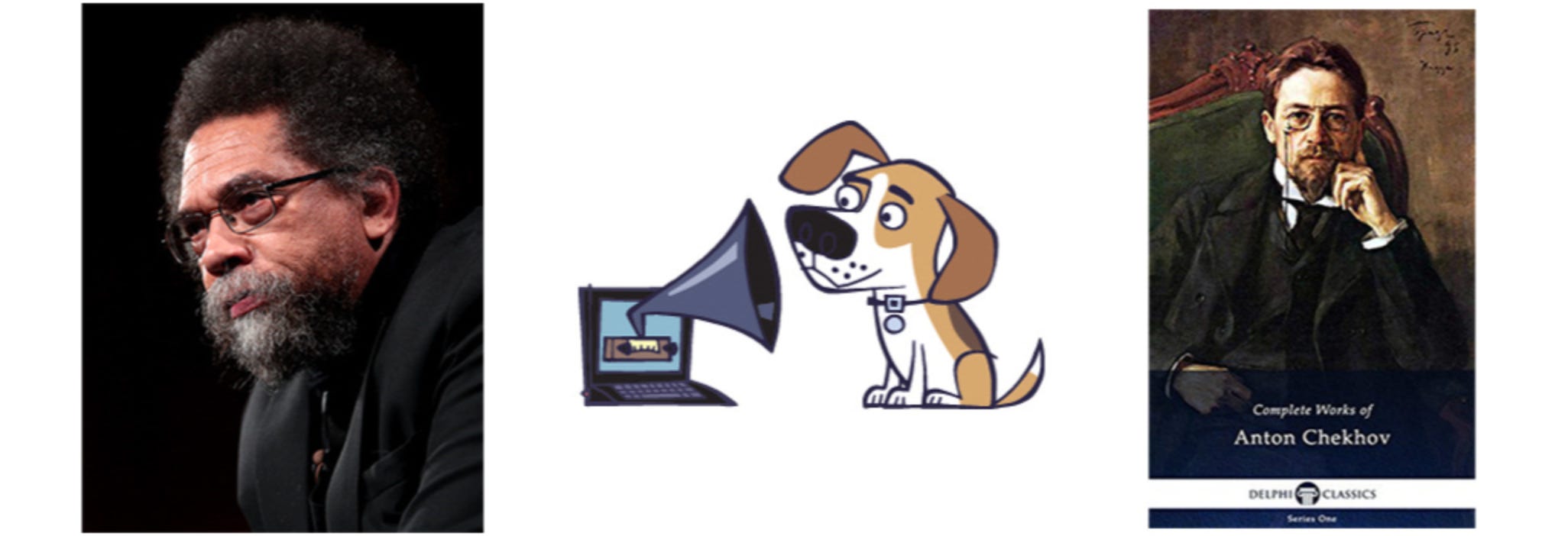
(The full Dish returns on September 4. In the meantime, we are re-airing a handful of the most downloaded episodes from the early years of the Dishcast.)
The academic career of Cornel West is long and storied. He has taught religion, philosophy, and African-American studies at Yale, Princeton, Harvard, and Union Theological Seminary. He has written or contributed to more than 20 books, including Race Matters and Democracy Matters — but he recommends you start with Chekhov.
I met Cornel decades ago, when I interviewed him at Union Theological Seminary for a TNR piece I was writing on divinity schools. He has long fascinated me, and Race Matters had a real impact on me decades ago. Erudite, passionate, and deeply humane, he is an unapologetically leftist Christian who is also a champion of free speech, civility, and the classics. In other words: a rare and beautiful man.
A key theme of the Dishcast is a willingness to talk to anyone across the political and ideological spectrum. We thought it would be cool if we re-aired this episode alongside that with Charles Murray, a philosophical opposite, but also a deeply decent man.
Below are some of the listener emails we posted after the pod aired. One remarked:
Cornel West just exudes a cerebral, erudite, common (universalist) warmth and decency. Is this why he’s seemingly so out of fashion on the left?
Another quoted Cornel:
“We’ve got to fight the notion that whiteness is reducible to white supremacy.” Yes — thank you, Dr. West. This is my issue with how CRT is being disseminated. I don’t have any problems with teaching history — however reprehensible some of our predecessors behaved — but don’t teach children that they have some sort of original sin based on their skin color.
Another fan:
Cornel West converses; he doesn’t robotically recite dogma. There’s a very smart, thinking human being there who listens, responds, thinks independently, and speaks his mind. I’ve always liked and respected him.
Yet another:
Cornel West is like a cold glass of water and a fresh breeze after being stuck in a hot, airless room full of people senselessly yelling at each other. We have to talk with each other face to face. We have to find some common basis — however tiny — from which to disrupt this tribalist, essentializing, paranoid, mutually polarizing hysteria.
On Cornel’s deep love for the humanities:
I found very interesting Dr. West’s response to your question of who people should read more of. His response was Chekhov. Now, critical race theory would tell you that Dr. West — a black man — shouldn’t find too much in common with Chekhov — a dead white man. But in fact, the opposite is true.
Moreover, Dr. West’s analysis of Chekhov’s work wasn’t a critical-theory analysis of cis, white, patriarchal, capitalist, etc, etc. Rather, it was a fundamental engagement with. the. text. — can you hear the annoying clapping? — and what that text says about the HUMAN condition.
I think there is something deep to this, especially in our current cultural moment. That a black American professor in 2021 finds such deep communion with a Russian white playwright from (roughly) 150 years ago … worlds apart, and yet deeply connected.
And this is the real beauty of a liberal education — you can commune with anyone outside your own “lived experience” and learn from them. Their identity matters far less than their ideas — and the more cultural and historical boundaries we cross the more we stand to learn.
The Dishcast devoted a whole pod on the humanities when we had on Roosevelt Montás in 2022. A fan wrote at the time:
Thank you for the wonderful conversation with Professor Montás. It reawakened the same spirit I had 28 years ago when I walked on the campus of Columbia University as a freshman. I remember being bored by the Iliad, stymied by The Republic, infuriated by Hobbes, and feeling overmatched by Nietzsche and Freud. I often hated the workload and the two-year campaign that asked me to read, think, engage, and discuss with my professors and classmates.
But I could never deny that it asked me to do something important and novel: wrestle with the ideas of others. I was not permitted to dismiss them out of hand or avoid the hard work by pointing to false controversy. I had to grapple with difficult ideas and develop the analytical skill and tools of language to explain why an idea did or did not make sense. And the value of that struggle has never left me.
Since then, during the two tech-focused decades we have experienced, it’s been easy to forget about ancient wisdom. I have fallen victim to the ever-growing pressure to look to circuits and microchips for new solutions to the problems of life. That effort is futile. In my calmer moments, when I sit in a quiet room, I remember what I learned with those great books, and how to find peace in the effort of seeking truth with the words of those who fought the same battle many centuries and even millennia ago.
The episode made me feel like a 19-year-old student again, and that was glorious. In fact, I stopped at a bookstore to buy Augustine’s Confessions before the episode was even over.
Lastly this week, here’s a reader eager to see the full Dish return:
I hope you’re enjoying your break, but I’m having a bit of contest withdrawal while you and Chris are having your well-earned time off. Helping to ease the lack of window views while the Dish is on hiatus, I was able to visit the site of the Vancouver window view from contest #509, which you generously awarded me the win for. It turns out my son and his girlfriend live about a mile from that building. Here they are with their Formosan Mountain Dog mix, pointing in the general direction of the window:
The kicker: they named him Bowie. (And I had nothing to do with that, hand to my heart.)