


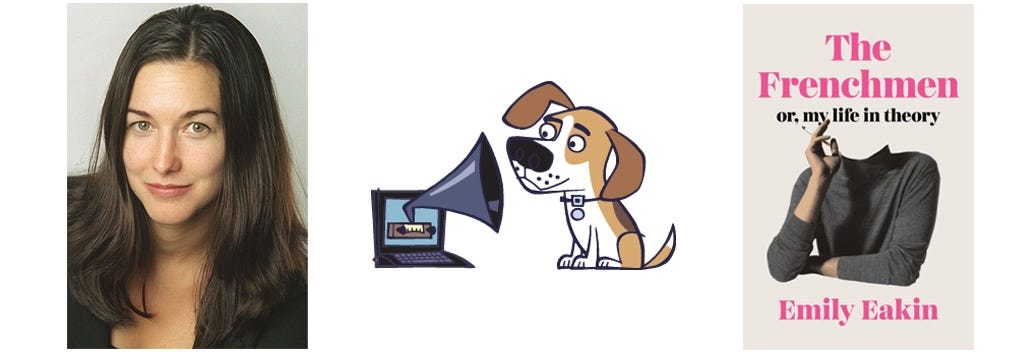
Emily is a senior editor at the New York Times Book Review. She’s also worked as a senior editor at The New Yorker, an ideas reporter for the NYT, a fashion features writer at Vogue, and a deputy editor of Lingua Franca magazine. Her new book is The Frenchmen: Or, My Life in Theory.
A polished transcript is here, including money quotes. Below are timestamps for the main sections of the pod:
03:56: Emily’s upbringing in a Francophile family
14:27: The postmodern idea that language is everything
31:05: The postmodern New Right
41:14: The dark dysfunctional lives of many of the French thinkers
103:27: The fatalism in pomo discourse
117:14: How Emily became skeptical of postmodernism
For two clips of the episode — on the word games of postmodernists, and the screwed-up lives of Foucault and others — head to our YouTube page.
More topics: Emily growing up in Indiana with regular trips to France; the country’s post-war boom but drop in world status; colonial revolt in Algeria; Heidegger and Nazism; Barthes and Maoism; Derrida and language; Levi-Strauss and structuralism; Camus and existentialism; nihilism; bourgeois as an epithet; Lacan and the unconscious; Althusser strangling his wife to death; the Straussian cult; Allan Bloom; the Sokal hoax; Stanley Fish and deconstruction; John Boswell and homosexuality; Foucault deconstructing gayness; the AIDS crisis; the prison system; Orwell and Oakeshott; Sarah Bakewell on Montaigne; HR and pronouns; the fatalism of Coates; and Trump’s exec orders on language in government.
Browse the Dishcast archive for an episode you might enjoy. Coming up: Michael Lewis on the bureaucrats who fought back against Trump, Evan Barker on how the Democratic Party got hijacked by elite activists, Sean Illing on the relevance of Camus and Nietzsche, Catherine Conybeare on Augustine, and Cyrus Habib on leaving politics to become a Jesuit priest. Please send any guest recs, dissents, and other comments to dish@andrewsullivan.com.
The View From Your Window

Alexandria, Virginia, 2.20 pm
Cruel And Unusual Punishment
There is a moral case for the death penalty, however much I oppose it. Some crimes really do cry out for retribution, and the horrific torture and murder that Christa Pike committed surely qualifies. Part of the moral case is that a society needs to stigmatize certain hideous crimes, to send a message that some things cannot be tolerated. I get that. And you can argue that if a fairly convicted murderer is simply being held proportionately accountable, there is a certain dignity in that. Dignity also in that it was once common for the soon-to-be-executed to forgive the person designated to commit the killing. Gruesome but in a weird way, dignified: last words, solemnity, etc.
Now consider Tennessee’s execution earlier this year of Tony Carruthers, convicted of a triple murder in 1994:
Staff members poked Mr. Carruthers repeatedly with needles, on both arms and then in his feet, as they tried to find a vein, according to his lawyer. Then came a shot of lidocaine as a doctor sliced into his chest to try to reach a larger, deeper vein, leaving him groaning in pain. After 90 minutes, the phone in the death chamber rang. They were ordered to stop.
Staggeringly, this is the norm, not the exception:
Advocates had expressed alarm last year after the state executed Byron Black, a 69-year-old man convicted of killing his girlfriend and her two daughters, despite him having a heart implant with a defibrillation function that could shock him as he died. Witnesses said Mr. Black, who had intellectual disabilities and numerous health issues, appeared severely distressed, saying, “It’s hurting so bad.”
Medieval. Both Mr Black and Ms Pike are, amazingly, still alive, but their human dignity has been as permanently violated as their bodies. If a vet had bungled a similar operation with a pet, criminal charges could be brought. But for the state with a human being? Total immunity. And when you see how these botched protocols have continued on and on despite the horrors, you realize that this is partly the point: to sustain the demonization of these awful criminals until the hour of their death. Their well-being matters not a jot.
That’s not justice; it’s sadism, and a violation of core human rights. A teenager can slip into painless death with a mere puff of fentanyl but we cannot execute someone painlessly and with dignity?
The governor of Tennessee has suspended all executions as they figure out what went wrong again, but it would be better if that suspension never lifted. A society that executes its criminals with this level of cruelty and incompetence is, quite simply, barbaric. Pike was a mere 18 years old when she murdered and tortured Colleen Slemmer. There’s no defense of what she did. But is life imprisonment for a teenager not punishment enough?
The Happy Socialists
One of the social fault-lines for a few generations of Brits until the late 1970s was an IQ test every child took at the age of 10 or 11. If you passed the “eleven-plus,” as it was called, you went to a “grammar school” — a magnet school with similarly clever kids; if you didn’t, you went to a “comprehensive school” that focused on more practical skills. The resentments this crude dividing line spawned tell you a lot about post-war British culture, and its suspicion of strivers and success, leading to a Labour government abolishing the exam in the 1970s — as a symbol of its working-class loyalty.
I thought of this legacy while watching the new British prime minister’s conference speech this week in Liverpool. Andy Burnham wowed the crowd and the pundits with a nostalgic elegy to the Britain before Thatcher. That was a country where, in his telling, everyone was taken care of and everyone was happy, because the government held everyone in its loving arms. It controlled the car industry, the energy sector, education, water, health, housing, steel, coal, and transportation — and, Burnham told us, he was going to bring all that back, and undo the cruel era of “neoliberalism.” And he was doing it because of his dad, a working-class man, who had prospered with government beneficence:
[Britain] made working-class aspiration feel real for families like mine. We built the common good. Or at least we did until the 1980s.
That’s the pivot: Margaret Thatcher made everything worse, and everything you’re suffering from now is her fault and Tony Blair’s fault for copying her. And then the personal aside about Burnham’s recently deceased dad that tells you everything:
If only, if only he had been able to appreciate that moment of the family in Downing Street. The son of a man who failed his 11 plus becoming prime minister.
That’s the message: those once left at the back and still struggling are now out front. This is gut, atmospheric class politics, and it works. Labour is now back in the polling lead and has a clear, if old-school, identity again. Nothing woke in the speech at all: just old-time class solidarity combined with genuine patriotism.
I thought the most powerful moment in a sometimes moving speech was when he referred to the push by Wales and Scotland to seek independence from the UK:
On the day my dad died, the Scottish First Minister said I would be the last Prime Minister of the United Kingdom. I quote that not to seek sympathy … I relay it because I want you to know how it made me feel. Utterly determined to prove him wrong.
The grit in that delivery was quite something.
Let me say up front I don’t believe a new burst of socialism is going to revive the UK. But Burnham’s plans are very vague, and the most striking was the idea of trimming state pensions to subsidize better home and social care — not exactly revolutionary. The money simply isn’t there for much else, and the bond markets are already dodgy.
But I do think that an emotional appeal to working-class distress, shorn of woke posturing, and buttressed by fond memories of the pre-Blair, 20th-century Labour Party, is good mood politics. Burnham made Labour loyalists feel warm inside again, and he seemed as real and charming as Starmer was wooden and dull. That matters.
And you know who he reminds me of? Zohran Mamdani, the socialist who seems to be behaving like a popular, practical mayor who never fails to give good video, and also occasionally acts out of the box — like his genius idea to give away 70,000 tickets to the Metropolitan Opera. The money isn’t there for most of Mamdani’s more ambitious schemes either, but sometimes, performance can go a long way in politics. And for these happy socialists, it seems to be working.
Money Quotes For The Week
“Free Luigi, for one,” - Roxanne Gay, NYT columnist, responding to a question about what to do about healthcare at a Harvard Medical School event.
“You got a freako. Notice the way all of a sudden he’s eating meat. He doesn’t eat meat. He’s a vaygan, and you know what a vaygan is? Vaygans don’t do well in Texas. So now he goes to a barbecue and eats meat. You know what he does after he eats? He goes behind a tent and throws up. He gets rid of the meat,” - Donald Trump on James Talarico.
“Weird how the people who said Mamdani would institute Sharia Law in NYC aren’t more vocal about this,” - Ryan Satin on Hegseth announcing the Office of Religious Affairs at the Pentagon.
“26 percent of young Republican men blame their problems on women. 66 percent of young Democratic women blame their problems on men,” - Frank Luntz.
“You might feel like you are a boy, you might feel like you are a girl. You might feel like you’re a boy even if you have body parts that some people might tell you are ‘girl’ parts … No matter how you feel, you’re perfectly normal!” - what second graders are being taught in New Jersey about being male and female.
Yglesias Award Nominee
“No, I don’t support sex-change surgeries for kids,” - James Talarico in a new campaign ad.
Mental Health Break
A pop song performed by 144 actors — so well done:
In The ‘Stacks
Who’s the big winner of the Iran war? The Saudis.
What would be the consequences of a Trump ban on diesel exports?
The Pope’s humanity went viral this week.
El-Sayed is over-performing with Trump voters.
“We’ve spent decades raising teacher quantity,” writes Noah Smith, “when we should have been raising quality.”
Why are England’s schools kicking ass?
Flu season is “coming in hot and early,” says Your Local Epidemiologist.
A debate between Steven Pinker and Scott Alexander over AI doomerism.
After the fiasco at Last Ditch bar, Julie Bindel tackles “lesbian fragility.”
Helen Pluckrose asks, “Is it homophobic when women are not attracted to bisexual men?”
It’s becoming rarer and rarer for Americans to host friends at home.
Eboo Patel describes how DEI “demeans minorities.”
Did psychedelics help build ancient civilizations?
Cailey Rizzo writes a beautiful and wise essay on Anthony Bourdain.
Did you know that Elvis nearly became a monk?
An ode to Eisenhower begins, “He hated and despised the smallness and pettiness of everyday politics.”
The View From Your Window Contest

Where do you think it’s located? Email your guess to contest@andrewsullivan.com. Please put the location — city first, then country — in the subject line. Proximity counts if no one gets the exact spot. Bonus points for fun facts and stories. The deadline for entries is Wednesday at 11.59 pm (PST). The winner gets the choice of a VFYW photo book or a two-year Dish subscription. If you’re not a paid subscriber, please indicate that in your entry and we will give you a free month subscription. Happy sleuthing!
Dissents Of The Week
A reader thinks I was too lenient in my latest piece:
I think you’re right in general that in moving forward from this disaster of Trump — if we are able to move forward, which I still find a dubious prospect — Americans must forgive and embrace each other. But …
Forgiveness does not mean absolution, and it cannot mean a “clean slate” — especially not for folks like Gerard Baker who knew perfectly well what was going on, knew it was evil, and continued to promote it for their own self-indulgent reasons.
I’m happy to forgive my right-wing, crank, next-door neighbor for his idiotic politics, as I figure he probably forgives mine (we live on a lively “fall yard sign” block in our Boston suburb, so there’s not much mystery about anyone’s preferences for Election Day). He’s sincere. I think he’s misguided about some things and just plain wrong about others, but I don’t think he cynically supports things he knows to be wrong. He’s just a decent guy who thinks the 2020 election was stolen, and for some incomprehensible-to-me reason thinks Donald Trump “tells it like it is.” If and when he comes around on Trump, it won’t be an “angle.”
But the Gerard Bakers of the world? Nah. They knew it was a cult of lies; they knew those lies would hurt real people; and they told everyone to get in line all the same. Not because they calculated that all the lies and the harm would serve some greater good, but because it was professionally expedient to do so.
Point well taken. Here’s a dissent over last week’s pod:
I’m writing in response to your discussion with Jacob Weisberg, specifically your defense of the Trump vs. United States ruling, which gave US presidents basically absolute immunity from prosecution. You made a defense of the decision, in that presidents should not be harassed by lawsuits, brought to account for the death of a person due to a decision (e.g. cutting a health benefit).


