


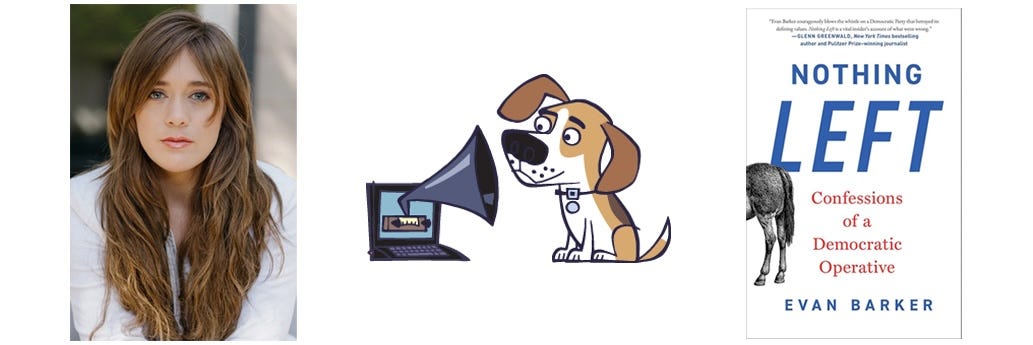
Evan is a former campaign fundraiser and political strategist for Democrats. She just published her first book, Nothing Left: Confessions of a Democratic Operative, which really blew me away. She’s also a writer and podcaster on Substack.
The episode was recorded on October 13, 2026, and aired on October 16. A polished transcript is below. Timestamps for the main sections:
02:18: Evan’s upbringing in a poor, tumultuous family
21:44: Her illness that led her to volunteer for Obama and his ACA
33:43: When she started to turn against Democrats
57:51: Getting canceled for being a “fragile white woman”
111:55: The death of her veteran brother and a woke disdain for patriotism
123:21: Her vote for Trump as a reactionary protest
For two audio clips — on her lifelong illness that drove her to campaign for Obama, and the woke dominance of Dem donors — head to our YouTube page.
More topics covered: how unions helped Evan’s family; the many marriages of her parents; going to 10 different schools; instability with money and healthcare; becoming a first-gen college grad; progressive activism; Bernie and AOC; the colorblind message of Obama; Hillary’s shift to identity politics; the smug elitism of Dem operatives; nepotism; weaponizing “oppression”; the Dem suspicion of straight men; Evan’s “masculine” approach to fundraising; the woke pipeline of the Ivy League; Kaepernick’s knee; oikophobia; immigration and the border; the ICE overreach; the silence of scared liberals; and how Dems haven’t gotten the message after 2024.
Money quotes from Evan:
“My mom could have a wild temper, and the men that she chose to marry could also have tempers. So yeah, I saw things like wine glasses getting thrown at heads and us taking off, and stepdads chasing us down the street and police getting called and all of those fun things. It affected me negatively, but it also affected me really positively — and I choose to focus on the positive. I have always done really well at adapting to situations.”
“I wasn’t actually diagnosed [with PCD] until I was 15 years old, but I was sick my entire life. When I was born, they gave me a 50-50 chance of living. The book was originally titled Born Blue, because I was born blue and then became a Democrat for the same reason. It was hard at times for my parents to get me health insurance.”
On working for the Obama campaign in 2008: “I felt very accepted and included. And it was so unique; there were people from all different walks of life, different backgrounds, different demographics. I wrote in my book it was not uncommon to see middle-aged, church-going black women working alongside 70-year-old white men wearing trucker hats that had been in unions their entire lives.”
On the vibe she got from Dem elites: “‘You’re from Dumbfuckistan, the part of the country that just elected Trump, thanks a lot.’ And so, I started noticing these class differences and found myself disconnected from the establishment wing of the party. It seemed like they had changed a lot; they were no longer what Obama was in 2008.”
“I think 2020 was when it was undeniable. It really, really hit me in the face, but to be honest, I saw flashing signs before that. I think the biggest one was when AOC was planning to come to town with Bernie and to support a white man — a white, male, straight candidate — and there was a mob that formed on Twitter that started blasting her for supporting him over the woman of color, lesbian, MMA fighter.”
“I like to joke, ‘I don’t believe in any kind of DEI, but if the Democratic Party were going to embrace DEI, they should probably hire more white men, to be honest with you.’ And people get really mad at me when I say that, especially in communications roles, because it’s just so clear that they’re not represented anymore in the Democratic coalition.”
“There is this desire to focus on these [identity] things vs. expanding healthcare access or taking on Wall Street or breaking up corporate monopolies, because it’s a way to get around doing the things that would actually materially change people’s lives. It doesn’t cost rich people anything to be woke.”
Browse the Dishcast archive for episodes you might enjoy.
Full Transcript
Andrew: Hello, hello, hello from our first Dishcast back in Washington, DC. For the fall — although it feels like summer out there — it’s beautiful today. I want to thank you first of all for keeping your subscription. And for those of you who haven’t subscribed, to ask you, please do. We really do need your support. This is a podcast that has no ads, no sponsorship. We’re not going to try and persuade you to buy lawnmower at some point. It’s a very pure thing. It’s you, me, the guest, and that works only when you keep your subscriptions. Thank you so much for doing that.
Please keep them coming, because we do have some pretty amazing guests coming up. We have Michael Barone, who’s going to come back a little bit out of retirement to talk about the midterms. Francis Fukuyama is coming up to talk about his memoir. Hamish McKenzie, one of the founders of Substack, is coming on to talk about journalism and Substack. We have Cynthia Burack on what gender studies has done to the university. We have Cyrus Habib, a man who went into politics and now has become a Jesuit priest. Plus, whole podcasts on Augustine, Pascal, and Aristotle. That’s part of our Big Think kind of series. So, some pretty amazing guests coming up, some wonderful conversations.
Today, we’re going to be more politics-focused. I’m talking to Evan Barker. She’s a former Democratic campaign operative and political strategist. She was a real foot soldier, more than a foot soldier, in the progressive movement as it began and as it continued. And she just published her first book, which really blew me away. I vibed, if that’s the right word. Suppose I’m a white person using the word “vibe”, but I’ll go ahead and do it anyway. I vibed with this book sentence after sentence. She’s a writer and podcaster also on Substack.
Evan, lovely to have you. Nice to see you.
Evan: Thank you so much for having me. It’s great to be here.
Andrew: Why did your parents call you Evan? Was it like a Boy Named Sue? Was it to toughen you up?
Evan: It was actually from my grandmother’s side of the family. It’s part of a surname. And so, I think my mom did it to honor my grandmother who, as you probably could tell from my book, was a great influence in my life and still is.
Andrew: Tell me about her.
Evan: Partially raised me, to be honest with you. She’s somebody she has no more than an 8th grade education. She was born in the southern part of Missouri, the Ozarks. That’s where my mom’s entire family comes from, actually. And she worked pretty difficult jobs her whole life. She worked in greenhouses. She worked in factories. She was a mother to two daughters. She married someone when she was very young. She married someone when she was only 16 years old, I think, and met when she was 13. He was drafted to the war in Korea and came back a completely different person.
And there was a lot of early physical violence in my mother’s early life. And she ended up leaving him when she was still a teenager and moved in with her parents. And eventually he showed up at one point with a gun and tried to get her to take him back and ended up getting arrested and then later pardoned by Richard Nixon. And my mom really didn’t have anything to do with him for most of her life, only met him a few times. I met him once when I was a little girl. I don’t remember it. It was on his deathbed and he was dying.
And she ended up getting remarried later to a man that I called my papa. He was really my grandfather. He was an elected official in the union in Missouri and they were together for 15 years. And unfortunately, he ended up leaving her when my mother was 18. But he was still a part of our family. And I mean, he was my grandfather and treated my mother as if she were his own daughter. So she’s somebody that’s had a hard life. She lived with my great-grandparents for over 15 years when I was a child, because she could not afford her own place.
Andrew: Is it your grandmother?
Evan: My grandmother. Yeah.
Andrew: Your grandmother and your mother were with your great-grandparents?
Evan: At one point, it was my mother, me, my grandmother, and my great-grandmother all living in the same cottage that my great-grandpa built with his own hands in the 1960s. Multi-generational living. But yeah, she’s always been — I remember when I was a little girl, I would pray to God every night that my grandmother would get enough money to have her own place and to just be able to survive. She’s still alive. She’s very jovial. She’s very happy. She’s 89 years old.
Andrew: Wow.
Evan: I saw a lot of depression around her too and a lot of sadness, but she’s a fighter. She’s really strong and has a really great attitude towards life.
Andrew: How about your mom?
Evan: My mom. My mom and I’s relationship is a bit more complicated than I lay out in the book. I’ve always felt like my grandmother was — I just felt more connected to her, I guess, personality-wise. I love my mother, but I think I related more to my grandmother and just her being scrappy and never giving up. My mom, my mother, has been married six times.
Andrew: Whoa.
Evan: Yeah. When she was younger, I mean, she was a knockout, gorgeous. My grandmother looked like Loretta Lynn, a lot like her when she was younger. My mother looked like Farrah Fawcett or a modern-day Sydney Sweeney. She was really beautiful, very blonde. And I think that when she was younger — and she would say this to you, that she relied on her looks a lot and relationships with men to get her through. And I think that that worked well when she was young. But as she’s gotten older, it’s been more difficult. Life has been a lot harder for her.
Andrew: Is she married now?
Evan: No. Her final marriage was when I was a junior in high school.
Andrew: So, what was your experience growing up in this multi-generational household at times in Missouri, right?
Evan: Everybody’s childhood is complicated. Mine was very confusing. In some ways, I’m still processing it. My dad was married five times. My mother was married six times. Some of those marriages happened before I was born, to be fair.
Andrew: That is more complicated than most, Evan.
Evan: I know. But I don’t want to make a big deal out of it.
Andrew: It’s just part of the story.
Evan: Well, poor me.
Andrew: It’s part of the story. No, you’re not saying poor you. Just explaining how you are where you are.
Evan: Yeah. So my parents divorced when I was only 10 months old, and when they were together, they had a nice middle-class home. And then my mom and I moved from there when I was 10 months old into — this is before my grandmother moved in with my great-grandmother, into the mobile home that my grandmother had in Belton, Missouri. And so, we moved there and lived there. I lived there for the first few years of my life.
And then my dad remarried. Charles’s mother, who I write about — or sorry, didn’t remarry. He married Charles’s mother when I was about three.
Andrew: Charles is your stepbrother, as you call him in the book?
Evan: Yes. And then my mom, when I was about three-and-a-half — about six months after my dad got married, I think she was a little jealous of my stepmom. My stepmom looked a lot like her, but was 15 years younger. And so, she ended up marrying somebody new as well, and that lasted for a couple of years, and then they ended up divorcing. I went to about 10 different schools between the ages of kindergarten and high school, and all sorts of different living experiences too. I think that’s the other thing that’s interesting about my story to some people is that I had the experience of living in middle-class homes in the suburbs, but then also the trailer park and rural areas and the inner city. When I lived with my great-grandmother, I went to a majority black school. I had the experience of being a minority as a white person. So I got a taste of all facets of life.
I think that, yeah, there was a lot of instability. There was a lot of financial instability, and I think that that was part of the reason that my mother remarried often. Some men get really upset when I say this online. It is callous, but yes, she definitely married at times for financial comfort and stability and to get me into better schools.
Andrew: How did that all affect you growing up? That’s obviously a huge amount of instability. I mean objectively — instability doesn’t mean that subjectively it felt that way. If it didn’t feel that way, what was it that helped you not feel that way?
Evan: It did feel that way, but I didn’t really know at the time it wasn’t normal. There was a lot of fighting too. My mom could have a wild temper, and the men that she chose to marry could also have tempers. And so, yeah, I saw things like wine glasses getting thrown at heads and us taking off, and stepdads chasing us down the street and police getting called and all of those fun things.
But I think what it did is it affected me negatively, but it also affected me really positively — and I choose to focus on the positive. I think that it made it so that I have always done really well at adapting to situations. When you’re the new girl at a school every year, you learn how to interact with all types of people and to constantly have to introduce yourself and you care less about what other people think of you. I think at least that’s how it impacted me. I wasn’t a very self-conscious teenager.
Andrew: Yeah. Because you didn’t have time.
Evan: Right.
Andrew: That’s the one thing about growing up in stress and pressure. In some ways, some of these things you hear about teenagers going through, you’re just like, “Well, that didn’t happen to me because I had to worry. I had to get home one time or I had to get my schoolwork done or I had to deal with my parents screaming at each other.” And it gets a bit of survival mechanism, but also presumably you had a little bit of your grandmother’s pluck. It seems you do; you’re plucky; you’re ballsy.
Evan: Yeah, she has a great sense of humor. She’s so funny. She loved that I wrote in the book about her that she is never afraid to say what she really thinks, especially after a few margaritas, which is true. She loves her margarita. Even though, yes, there was lots of instability, there were a few stabilizing forces as well in my family. And one of those was the construction union that my grandfather was an elected official in, and where he got all of my uncle’s jobs in the unions as well.
And there’s this mobile home park in Missouri that I have a deep attachment to, because I have so many childhood memories there. But my grandfather lived there with my step-grandmother for a part of my childhood. My aunt and my uncle lived there with my two cousins that I was very close to, who I didn’t write about in the book. I’ve written about them elsewhere, but for whatever ... I cut a bunch of family stuff from the book.
And then I also, my grandmother and my mom and I also lived there. So, it was like, basically, I can go to almost each street there and have a memory. And I think that what I’ve realized as I’ve gotten older, growing up my grandfather really taught us the power of unions and how important it was to our family and the fact that he and my uncles could all have good jobs without having a college degree, and that the union would always be able to find them work, get them healthcare benefits.
And I think that that was the thing that kept my — at least the men in my family; my grandmother obviously was not in the union, a construction worker’s union. That would’ve been very uncommon back then for women to do. But it kept them from slipping into poverty. I grew up in a predominantly Democratic household. The first book that I ever learned to read was [about] my president, Bill Clinton. My mom used to read to me all the time.
Andrew: Well, there was another man who grew up in a trailer park at one point.
Evan: Bill Clinton?
Andrew: Yeah, right?
Evan: No. I didn’t know that.
Andrew: Yeah. [Correction: Clinton had a modest, small-town upbringing, but not in a trailer park.]
Evan: Probably.
Andrew: And which also had parental fights and drama and all the rest of it. I mean, a classic late 20th century life, which has lots of marriage and poor-income families.
Evan: My story isn’t that unique. I said that the other day. My story’s not that unique. It’s really not.
Andrew: No. What’s interesting about it is that it seems sounds unique to people who live in Washington, DC. It’s not unique to your regular human being out there, right?
Evan: Exactly. Yeah, it’s not. It sounds unique to people like that. It’s unique compared to the people that now orbit Democratic politics.
Andrew: And to some extent, Republican politics as well. I don’t know if Musk has an idea of what it is. Why don’t you tell us? Because those of us who’ve never lived in a trailer park, what’s different about it than living in a regular housing development or something?
Evan: There’s a lot of transients, people coming and going. I saw it transform over time. I think in the ‘90s when we were there, when my cousins were there, it was more of a sense of community.
Andrew: The way you described it earlier, it felt like one of those old working-class neighborhoods in the east of London or something where it was pretty shitty accommodation, but everyone knew each other. They went around to each other’s places. They had friends from other houses. They had cousins. They had relatives. They had everybody. I mean, where I grew up, every mom around us was called our “auntie” for some reason. They were just all honorary aunts.
Evan: Everybody.
Andrew: Well, we had Auntie Kris, Auntie — I mean, lots of them all over there. They weren’t related to us at all, but they all had semi-authority over the kids in the neighborhood. In other words, if they showed up, you had to take note.
Evan: Yeah. We had full reign. We could go wherever we wanted, as long as we stayed somewhat within the vicinity of the mobile home park. There was this big lake just outside of it that we would go play at. We’d often try to go sneak over to my grandfather’s house. And we didn’t have nice, fluffy, grassed, fenced in backyards. We played a lot on concrete. But it didn’t really matter. And I think as I saw it, I did see it deteriorate over time.
When the final few years my mother and grandmother lived there, they had to unfortunately sell it in 2020, because the cost of electricity and heating was very, very — the cost had risen so much, and the lot payments were rising to a rate that they could not afford. And there was one that caught on fire; the man died right behind them. And then there were neighbors that were dealing drugs, and somebody got shot in the street. And so, it just became a little bit more dangerous than I remembered it as a child. So even though I was sad that they were losing the place, I was happy in a way that they were leaving.
Andrew: Where were they able to go?
Evan: For about six months, they lived with my aunt and then they both got their own apartment, but my mom could not afford that apartment, so now she’s back with my grandmother. When I was at the DNC, they were sharing a one-bedroom apartment. I have helped them get into a two-bedroom apartment. And so, that is where they are at now. I have to give them money.
Andrew: It’s interesting to think of a family like that facing the kind of inflation that they’re now dealing with. I mean, gas and food and groceries, the things that — Donald Trump had never heard the word “groceries”. He thought it was an interesting new word that he discovered.
Evan: What? Really?
Andrew: He did a couple of years ago. He made some remark. He’s like, “Groceries, this word, has came up with this word. I’ve never heard of this word.” Well, of course he hasn’t. Why would Donald Trump ever have an encounter with the word groceries?
Evan: Right.
Andrew: But it is the most important part of most ordinary people’s week, and the price of it has gone through the roof. Anyway, I’m just talking to you because I do find your background, which is truly to have lived in the America of the late 20th century, early 21st century, it really is about living in the heartland of this country. Which then led you to become a progressive activist, essentially, to join up, organize politics, to raise money and organize in the Bernie progressive movement. And that’s a very classic American story in some ways. You came from a real background. You went into politics fueled by that sense that you could help these people.
The other thing that’s interesting about you is that, of course, you’ve always had a pretty rough health condition. Can you tell us about that? Because that’s also something floating around so many people who are stuck in these kind of situations.
Evan: Yeah. So, on top of all of that, I was born with a rare preexisting health condition similar to cystic fibrosis in the way that it presents symptomatically. It’s called primary ciliary dyskinesia, PCD for short. And I wasn’t actually diagnosed until I was 15 years old, but I was sick my entire life. When I was born, they gave me a 50-50 chance of living. The book was originally titled Born Blue, because I was born blue and then became a Democrat for the same reason.
It was hard at times for my family, for my parents, to get me health insurance. They couldn’t always afford to put me on high-risk plans. Before the ACA, you couldn’t get healthcare; you couldn’t get health insurance in this country if you had any sort of condition. This was before they even know what I had. They just thought I had asthma and I could not get insurance. And if my mom lost her job, and even when she had a job actually, I couldn’t always get health insurance. Sometimes her bosses would just say, “We cannot cover your daughter. It would cost our small business too much money.”
And so, there were times as a child where I went without healthcare and I had to put off surgeries. The condition can make you very sick. It affects many different parts of your body. The most life-threatening part is the lungs. There’s this secondary problem that occurs with people with primary ciliary dyskinesia where they get this thing called bronchiectasis, which is basically the lungs stop working overtime; it’s progressive. It’s like cancer; it’ll just keep growing and spreading throughout the lungs, and the tissue just completely becomes defunct. It’s lung damage, and it reduces your lung capacity over time. It also means that you are more susceptible to getting chronic lung infections, pneumonias.
I was hospitalized so much as a child, and I’m still very sick, to be honest with you. I’m sick right now, actually. I’m on antibiotics, but I’m just pushing through because I am so used to doing that. And that’s what you have to do if you want to live a full life with this disorder. But it also affects your hearing, so I’m missing 40 decibels in both my ears, and it causes sinus issues and infertility. I did have a child, but I had to do IVF. I was fortunate enough that my husband’s work paid for it so I could do that.
So I had this experience with this rare health condition and I think that, due to the fact that I didn’t always have coverage, it actually contributed to the fact that I got such a late diagnosis because we weren’t able to —
Andrew: No one was checking you out.
Evan: Right. Well —
Andrew: And why would they put all these things together?
Evan: My parents would pay out of pocket for me to go to a primary care doctor, an asthma doc, but it was hard for them to always afford specialists or get me second opinions in other cities. If I was born into a more affluent family, I have a feeling, yes, I probably would’ve gotten a diagnosis a lot younger.
And so, when I was in high school, I was really nervous because I really wanted to go to college. My mother went to one or two semesters of college and then dropped out so that she could start working full-time. She wanted to make money, she wanted to help my grandma. And my dad actually never graduated high school. My dad was rebellious; he hit his principal in the face and did not apologize.
Andrew: That will do it.
Evan: I think I might get some of my rebellious streak from him, actually, for sure. Although I’ve never done that, but anyway. So I really wanted to go to college, so I am a first generation college graduate. But I was nervous about it, because I didn’t know how I was going to get health insurance; I really didn’t. The best way it seemed was to go get a job right out of high school, which is what my dad wanted me to do, actually.
But I knew that, if I got President Obama elected, he promised that he would change it, and now I look back on that and I’m thinking, “Man, that was pretty naive,” that I just thought, “If I went and helped him, he would do what he promised to do.” Most politicians don’t do that nowadays at all, but he did. And I know that there’s a lot of problems with Obamacare, but I think that —
Andrew: Yeah, but I love it too. For someone also with — I’ve had HIV for 30 years. Having a serious health condition makes having health insurance a whole different feeling.
Evan: So different.
Andrew: It’s terrifying to be without it.
Evan: Yeah. Lifelong chronic medications that you need to literally stay alive.
Andrew: Yes, yes. And also short-term medications to keep you going through the night, to keep you breathing — which, in my case, was at times problematic.
But this is a positive story: you worked for Obama; he came through; he got [the ACA]. It wasn’t perfect, he didn’t have a public option or the rest of it, and they have not been able — they’ve done all they can to whittle away at it, but it has not gone. So that’s a very positive relationship between your life and politics. Tell me about your early time working for the Obama campaign and afterwards, in terms of fundraising and organization and how you got into that particular job.
Evan: So with Obama, I was very young; I was still a senior in high school. I did not do fundraising for him. I would look at his fundraising staff in awe from afar. I remember this woman, this beautiful brunette woman, was his Kansas City-area donor advisor. I don’t know what her official title was, but I knew that she did fundraising in the Kansas City area. But I was an organizer for him, and I was only in high school, so you’re probably thinking “How could you have really done that much work?” But I left school every day at 11:00 a.m., because I had completed enough classes to leave early, to get permission to leave early, and I would stay at his campaign headquarters from 11:00 a.m. to 8:00, 9:00 each night. And I talked to voters two to three times my age, telling them my healthcare story, trying to get them to get motivated to get this man elected.
And I got to meet him twice when I was doing that. I met Michelle Obama, Madeleine Albright, Al Sharpton, Star Jones — it was quite a formative experience. The other interesting thing is that I felt — and especially as I compare my experience then to my experience later in Democratic politics — I felt very accepted and included on that campaign. And it was so unique, in the sense that there were people from all different walks of life, different backgrounds, different demographics. I think I wrote in my book it was not uncommon to see middle-aged, church-going black women working alongside 70-year-old white men wearing trucker hats that had been in unions their entire lives.
And this was also back when Jay Nixon was running for governor of Missouri, so Missouri was still a bellwether state. We had Claire McCaskill as a senator. It was not the deep red state that it is now, it was very, very different back then.
And so, Obama came to St. Louis and he came to Kansas City, and they really dedicated a lot of time and resources in trying to win there, and I got to be a part of that. And I remember the night that he won, it was one of the happiest nights of my entire life. Years later, right out of college, I wasn’t very happy during this time, and I remember someone I knew asked me, “What was the happiest? When was the last time you were truly happy?” And I was like, “Probably November 4th, 2008.” And it really was one of the highs of my life, and I remember running out into the streets with all of my friends and watching hundreds of people dance to “Thriller” in the dark on the streets of Kansas City.
And it just felt like we had done something so important ,and it wasn’t even just electing the first black president — although that was definitely exciting, of course — but it was that he was going to be a president that came in and delivered and changed things after eight years of George W. Bush, economic recessions, and wars in the Middle East, and that he would be a president that really understood our generation. I was lucky in that he did change things for people like me —
Andrew: And me.
Evan: And you, exactly. They launched a national — I think, to get the country through that period, they launched a national high-risk pool that people could enroll into, which I did. And then, within two years, they started filtering people into marketplace plans, and I was on Obamacare all through college and after.
Andrew: Mm-hmm. I’ve been on Obamacare as soon as I could get it and I’ve been on it ever since, and it’s given me peace of mind that’s very hard to explain. I’m also fascinated because the Obama campaign was not actually about race.
Evan: No.
Andrew: It wasn’t really about identity; it was about America; and it was about making things better; and it was — and I, too, as part of that coalition, even though I’m basically a relatively right-wing white man who voted for Bush in 2000, felt completely at home. And he was one of the first Democrats I really felt uncomplicatedly positive towards. A lot of other people thought I was bonkers or become infatuated or swooning but no, no, no, no, no, I didn’t think that at all.
But, anyway, what’s interesting about it is the contrast between your experience in that era of Democratic Party politics and then, when you went on to become a real professional in that progressive movement, then how that coalition, how that movement shifted.
Evan: It shifted.
Andrew: Tell us when you first — well, tell us a bit when you got into working as a progressive activist, but then the first time you began to feel this inclusive, goal-oriented, aspirational, practical movement suddenly become something less something you feel in any way comfortable in.


