

2025 has had a couple of anniversaries for yours truly. The Dish turned 25. The Daily Dish, Deep Dish, The Weekly Dish, and The Dishcast all evolved out of that decision to throw my lot in with the web as a writer in 2000. I helped pioneer blogging in the early aughts, then my team innovated real-time 24/7 coverage of breaking news in 2009, then we achieved the first successful blog paywall in 2013. That, in turn, was the proof of principle for Substack, which has grown this year beyond recognition, and given us back the Dish community. To expand the freedom of writers to say what they want is something incredibly self-interested, of course, but also, I think, very American, especially the making-money part.
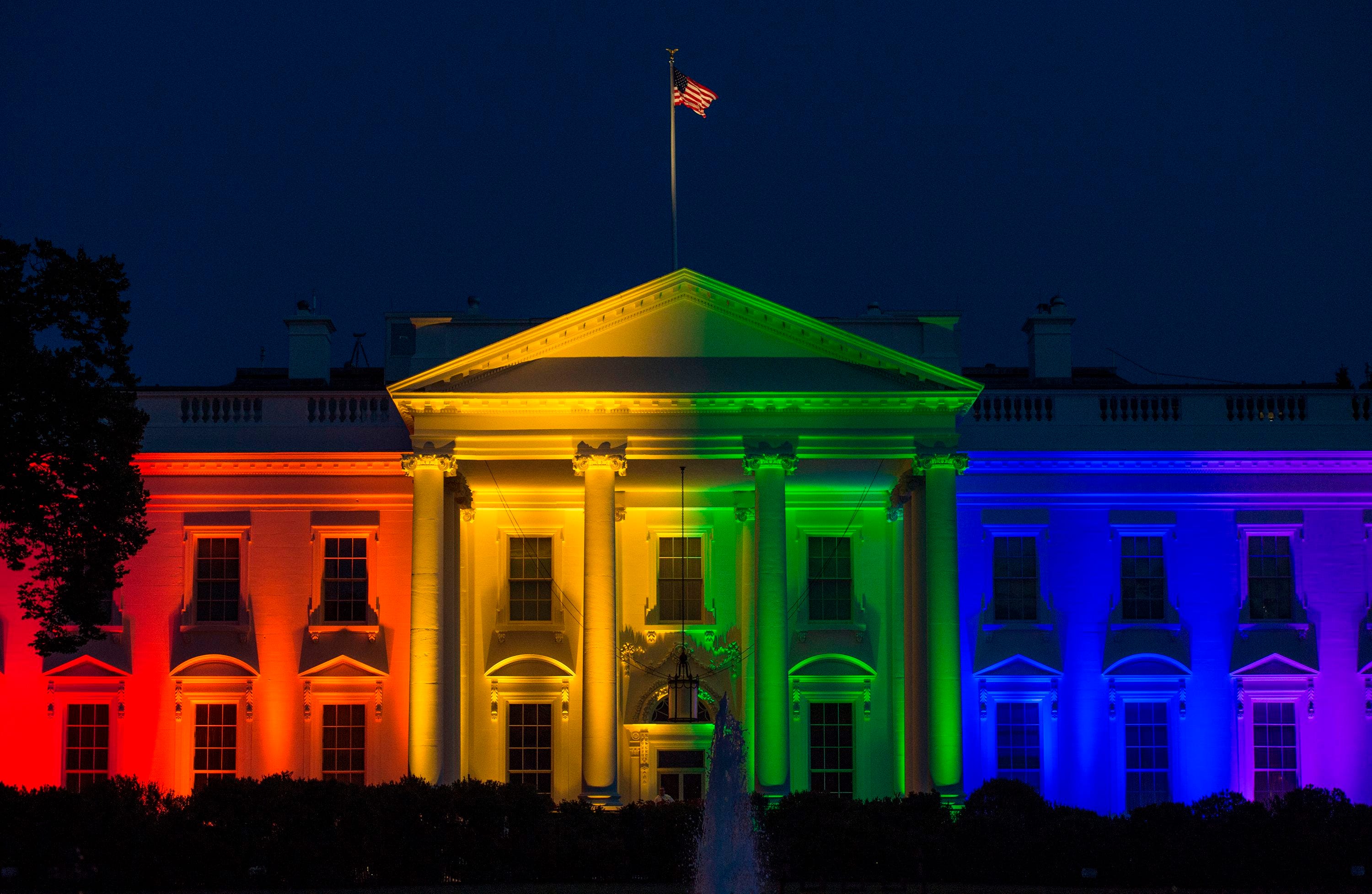
And then, of course, we’ve had ten years of nationwide marriage equality since 2015’s Obergefell decision — a cause I imagined, helped kick-start in 1989, and spent a quarter century arguing everywhere I could. It included my own civil marriage and, in true American fashion, my sad but amicable divorce more than a decade later.
“If you live long enough” is a cliché for a reason. And, against the odds, thanks to protease inhibitors, I did live long enough to see these two evolutions in media and society unfold. “Did they do more good than harm?” is a question I’ve found myself pondering in my third trimester of life. The media revolution? A truly mixed bag, I’d say, especially in the iPhone and now AI era. A story for another time.
But gay marriage? Personally, I feel I failed in my own journey, but nonetheless tried hard, and treasure the enduring love and deep friendship I still have with my ex-husband. My marriage helped me mature, grounded me more firmly, taught me what sacrifice and generosity can be. Maybe it will happen again.
And collectively? A much higher grade surely — with the caveat that we’ve only had a decade of evidence. My opponents feared it would destabilize marriage more generally. It didn’t. Marriage rates were 6.9 per 1,000 in 2015 and 6.1 today — a decline in line with the previous half-century. Not great, but there’s no sign that gay marriage had any serious impact. Divorce rates? They have actually improved since 2015: from 3.1 to 2.4 per 1,000 in 2023. One small contributing factor is that divorce rates among gay men are actually lower than that for straight couples. Who predicted that? Certainly not Bill Kristol.
How has marriage affected these gay men and lesbians? It’s been a boon. Married couples have higher household incomes, lower poverty rates, higher levels of employment, better health than unmarried ones, higher home-ownership rates — and report greater social acceptance. Gay men have been thriving in education:
Over half of gay men have earned a college degree, compared with about 35 percent of straight men. Some 6 percent of gay men have a Ph.D., J.D. or M.D. — a rate 50 percent higher than that of straight men … What’s more, gay men’s college graduation rate dramatically bests even that of straight women.
Before 2015, gay men earned around 10 percent less than straight men; now they earn 10 percent more. Married gay men have a median income of $142,000, compared with $125,000 for married straights. HIV infection rates have fallen by about 17 percent; and the mortality gap between gay and straight men disappeared by 2022. With no discernible damage to society as a whole, a previously marginalized group, emerging from a devastating epidemic, has integrated and prospered. That wasn’t inevitable; and it remains the most successful reform of this century.
The queer activists, of course, loudly insisted that same-sex couples rejected the institution of marriage and would never join it. But the number of married gay men and lesbians more than doubled from 390,000 in 2015 to 823,000 now; and nearly 60 percent of same-sex cohabiting couples are now married, compared with 40 percent in domestic partnerships. How has this reform been greeted in the country at large? Gallup shows that support has grown from 58 to 69 percent. In 2024, the GOP removed opposition to gay marriage in its platform. A married gay man with two sons is now the Treasury Secretary in a hard-right Republican administration — a more senior position than any openly gay Dem has ever held.
As social reforms go, it’s hard to do better than this. It sure hasn’t been a panacea for marriage as a whole, but it has shored up the thing a bit and broadened its base. And then there are things for which there are no statistics. The young mercifully don’t know much of the immense psychic pain, deep spiritual anguish, emotional trauma, and intense self-hatred that the past contained for so many of us — a pain far worse for the countless generations before.
The stress is not over, of course. It never will be when you’re a tiny minority, which is why resilience is what we need to foster, not victimhood. But so much darkness has abated, so much agony disappeared. So many weddings have healed someone’s soul or repaired someone’s family. No price can be put on that. I sobbed at the first wedding I attended — helpless, embarrassing sobs. So much pain had been welling up like water behind a dam; and then it broke.
The trouble, of course, is that success breeds its own set of problems. Successful civil rights movements — think of the mid-1960s — can radicalize and curdle. And as most normie gays got on with their lives, queer extremists duly took over the gay infrastructure and institutions, and the era of more general woke madness set in.
The goal was to re-marginalize us as “queer” again, to indoctrinate kids with leftist lies about human biology, and create an entirely fake history of gay and lesbian rights. Dissent was punished, old leaders ousted, and an ever-expanding alphabet of ever-more bizarre and niche identities — often approaching mental illness — replaced any idea of gay and lesbian identity.
They changed the flag and merged its colors with the BLM movement; they pioneered untested medical experiments on pre-pubescent children with gender dysphoria, including gay and lesbian kids; they sterilized them and rendered many incapable of orgasm for life; they perverted the English language — “chest-feeding” anyone? — and tried to abolish the whole idea of homosexuality as a distinct human experience, in favor of their generalized, post-modern, intersectional queerness. And they replaced the principles of live-and-let-live by forcing others to take the knee to their radicalism. No-enemies-to-the-left syndrome became a pandemic. Sore winners.
Then there was the Internet. It took a sledgehammer to gay communal life, as gay bars declined — and all but disappeared for lesbians — and hookup apps proliferated. Those apps did not just kill gay social life, they also imposed queer radicalism on everyone: on Grindr, for example, biological women were now deemed gay men if they said they were, and being a gay man now included vaginal sex. Want to filter out bio women? Grindr removed that option. The queers hate choice and fear freedom.
The left replaced homosexuality with queerness and sex with gender. Queer “journalists” imposed queer-theory terminology on the media and tried to shut down any reporting of sex changes for children. Many gay boys and lesbian girls were transed before they ever had their first orgasm (and many would barely have another one in their lives). The gay elites refused even to acknowledge their existence — and still couldn’t care less. And, of course, none of this was popular, got even less popular over time, and played a critical part in the re-election of Trump.
Part of this was surely just mission creep, as activists needed to find new niche causes to keep their funding up. Part was the general madness of the Great Awokening, which imposed new orthodoxies everywhere using fear and bullying. Part was the toxic influence of academia. Part was well-meaning straight people trying to make up for once opposing marriage equality by mindlessly backing anything “queer”. But part was also perhaps a broader failure of gay and lesbian nerve.
There is something easy about victimhood, after all. Everything wrong is someone else’s fault always. Any argument is ended by identity: whoever is more “oppressed” wins. (A trans person arguing with a gay person is always right and debate itself is oppression.) Any adjustment means “throwing people under the bus.” And because the normie gay majority is doing fine, they just let it continue. Who wants to be called a “transphobe” anyway? Who wants to be cut out of their social scene, disowned, or ostracized? Easier to book the next trip to a circuit party, diss normie gays on Bluesky, and blather about trans sisters and brothers than actually prevent gay kids being transed by fanatics by mistake.
Not a huge shock, of course. Human psychology is perverse and complex. Taking yes for an answer — and all the responsibility that comes with it — can be difficult if your entire identity has been constructed expecting a Big Fat No. I guess what saddens me most about this is what it has done to the next generation. For me, the great boon of marriage equality was that it could simply inform the young and gay that they too could be fully part of their families and society, whether that was in a red state or a blue state, helping reduce the anxiety, stress, and pain so many of us had to go through in our youth. You didn’t need to indoctrinate; the world would show them their potential if we just got out of their way.
The queers, however, saw a chance to get into the heads of the young very early, by capturing the educational establishment. They moved swiftly to indoctrinate kids — as young as kindergarteners — in the precepts of queer theory before their own sense of what being gay for them could naturally evolve. They told gay boys they could be girls inside, and gay girls they could be boys inside, and they could be cured if they wanted to be. They told them everyone had a “gender identity” (no, we don’t) and that their bodies had nothing to do with whether they were a boy or a girl (insane).
They told them that being gay included relationships with women as well as men. They replaced gay identity with “2SLGBTQIA+” ideology. They told them they were victims from Day One. No wonder that generation has reversed the gains in psychological health the older generations had won. The queers and the Internet fucked an entire generation up, and made them miserable. In a period of far greater acceptance, and full civil rights, making gay kids more depressed is quite an achievement and an extraordinary indictment.
I remain deeply proud of what we did. Nothing will ever take that away. The current madness is based on lies about human nature, and lies always fail in the end. We will emerge from it because it’s built on sand. Meanwhile, you carry on, hoping some kind of moderation will happen, but seeing no sign of it at all. I realize don’t belong in this intolerant “LGBTQIA+” community any more. And it doesn’t want me or any gay men like me. The price of success is always failure, I suppose. But the success was real.
(Note to readers: This is an excerpt of The Weekly Dish. If you’re already a paid subscriber, click here to read the full version. This week’s issue also includes: a thorough debate with Shadi Hamid over US intervention abroad; dissents over my column on the Caribbean killings; eight notable quotes from the week in news; 15 pieces on Substack we recommend on a variety of topics; a Mental Health Break of what the Bee Gees would’ve sounded like in 1577; a dusty window from Doha; and, of course, the results of the View From Your Window contest — with a new challenge. Subscribe for the full Dish experience!)
From a new paid subscriber:
I’ve been reading your free version for quite some time and realized a couple of weeks ago how much I look forward to seeing your weekly excerpt in my inbox. Excited to subscribe.
From a returning sub:
I’m long-time reader and off-and-on subscriber here. (Hopefully you understand that sometimes I can’t read your anxiety and manage my own.) The last time I paused my subscription, I wondered what would make me reactivate it.
Yesterday morning, when I opened the VFYW write-up and saw photo #487, I found out! I glanced at it and thought, “Huh, that looks an awful lot like downtown!” Zooming in confirmed that the photo really was taken three blocks away from my house, here in my adopted hometown of Hamilton! Of all the college towns I’ve lived in, it’s the smallest — and the one I’d have guessed to be the least likely to show up in VFYW!
So congratulations, you got me to resubscribe!
That’s all Chris’s doing. But we’re psyched to have you back.
Back On The Dishcast: Shadi Hamid
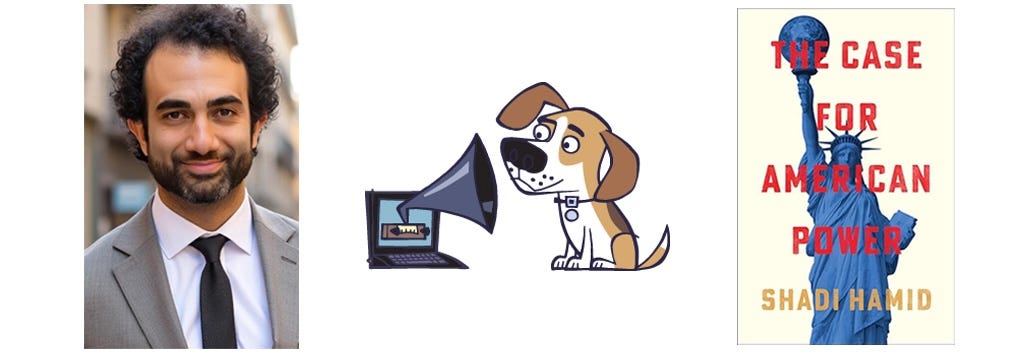
Shadi is a Washington Post columnist and a senior fellow at Georgetown University’s Center for Muslim-Christian Understanding. He runs a substack with Damir Marusic called Wisdom of Crowds, and his new book is The Case for American Power. It’s the third time Shadi has been on the Dishcast. We hashed out the National Security Strategy and the future of US leadership in the world, if any.
Listen to the episode here. There you can find two clips of our convo — on Bush’s idealism leading to anarchy in Iraq, and whether Trump’s amorality is stabilizing the Middle East. That link also takes you to listener feedback on our pods with George Packer on post-liberalism, Michel Paradis on Eisenhower, and Karen Hao on AI — plus an assortment of reader emails.
Browse the Dishcast archive for an episode you might enjoy. Coming up: Simon Rogoff on the narcissism of pols and celebrities (from Diddy to Churchill to Trump), Laura Field on the intellectuals of Trumpism, Arthur Brooks on the science of happiness, Vivek Ramaswamy on the right’s future, and Jason Willick on trade and conservatism. Please send any guest recs, dissents, and other comments to dish@andrewsullivan.com.
Dissents Of The Week
A reader writes:
Respectfully, I must take issue with part of your latest column. As someone who has an advanced degree in International Humanitarian Law, you have mischaracterized or misunderstood some of the laws of armed conflict:
There are legitimate controversies over various rules of engagement, but the laws of war are different. Killing civilians or unarmed soldiers or armed soldiers not posing any direct threat is not warfare; it’s murder. Killing enemy combatants who surrender or flee or are shipwrecked is what barbarians do.
Read the rest of that dissent, along with another one, here. Please keep the criticism coming — dish@andrewsullivan.com — and follow more Dish debate in my Notes feed.
In The ‘Stacks
This is a feature in the paid version of the Dish spotlighting about 20 of our favorite pieces from other Substackers every week. This week’s selection covers subjects such as the close fight for the Senate, Groyperification, and affirmative action for men. A couple examples:
An insight into the insanity that now defines the “LGBTQIA+” world.
TIL Epstein had a really weird dick.
Here’s a list of the substacks we recommend in general — call it a blogroll. If you have any suggestions for “In the ‘Stacks,” especially ones from emerging writers, please let us know: dish@andrewsullivan.com.
Heads Up
My latest diary for The Spectator, “Trump has made D.C. safe again,” is here.
The View From Your Window Contest

Where do you think it’s located? Email your guess to contest@andrewsullivan.com. Please put the location — city and/or state first, then country — in the subject line. Proximity counts if no one gets the exact spot. Bonus points for fun facts and stories. The deadline for entries is Wednesday at 11.59 pm (PST). The winner gets the choice of a VFYW book or two annual Dish subscriptions. If you are not a subscriber, please indicate that status in your entry and we will give you a free month sub if we select your entry for the contest results (example here if you’re new to the VFYW). Contest archive is here. Happy sleuthing!
The results for this week’s window are coming in a separate email to paid subscribers later today. Last week, a sleuth wrote:
Actor Kevin Heffernan is a Colgate alum, best known for ordering a “liter cola” as a Green Mountain State Trooper in Super Troopers: comedy ensued.
Ben Cohen of Ben & Jerry’s went to Colgate too, but didn’t graduate. Andy Rooney of 60 Minutes fame did. And the writer of the Christmas classics we’re all singing this time of year — “Rockin’ Around the Christmas Tree,” “Rudolph, the Red-Nosed Reindeer,” “A Holly Jolly Christmas,” “Silver and Gold,” and “I Heard the Bells on Christmas Day” — Johnny Marks, graduated from there too.
Another sleuth responds to that entry:
I thought it might be cool for your readers to know that Johnny Marks — writer of some of America’s most prolific holiday songs — was Jewish. In fact, Jewish composers wrote many of the most famous Christmas songs. Irving Berlin is one of the most notable; he wrote “White Christmas” (as well as “God Bless America”):
It’s emblematic of the amazing, multicultural country we live in to know that Jewish Americans contributed so much to the festive season.
See you next Friday.