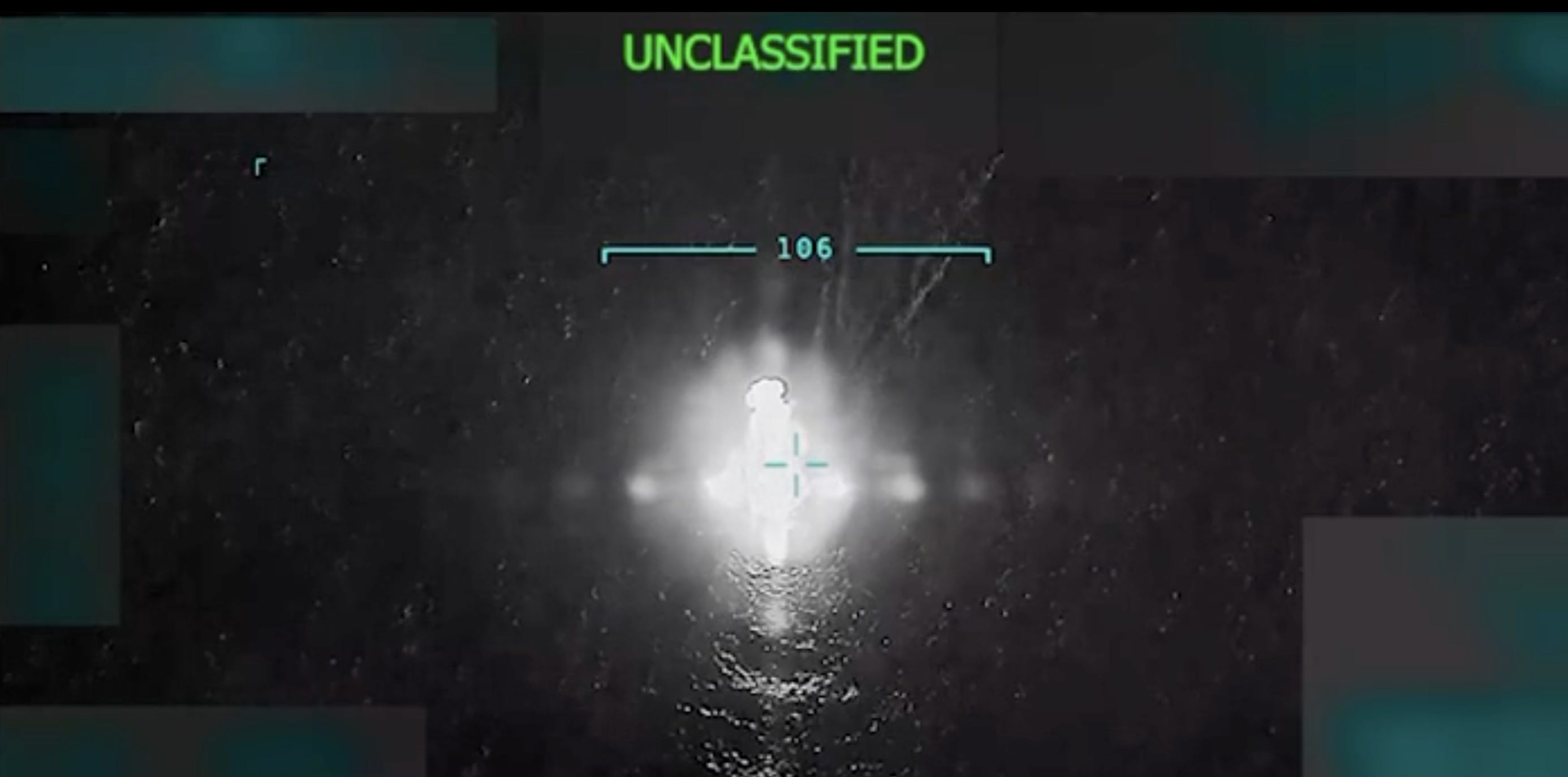
An image from a video released by President Trump on his Truth Social account.
“Defense Secretary Pete Hegseth seems to be a war criminal. Without a war. An interesting achievement,“ - George Will.
It is not easy to be newly sickened in the “moral slum” of this era in American history, but Megyn Kelly pulled off something special the other day. She was talking to Mark Halperin about President Trump’s undeclared “special military operation” — is that what we call this kind of thing now? — in the Caribbean. A boat allegedly carrying cocaine was struck by the US military under orders to “Destroy the drugs, kill all 11 people on board.” When two men on board survived the strike, a second one was ordered 41 minutes later to finish the job. Kelly was mad that the murder was ... too swift:
I really do kind of not only wanna see them killed in the water, whether they’re on the boat or in the water, but I’d really like to see them suffer. I would like Trump and Hegseth to make it last a long time so they lose a limb and bleed out.
At first I thought it was AI. No one, especially a lawyer like Kelly, would seriously air such a barbarous abandonment of the basic laws of war in America, would they? Russia? Sure. Iran? You bet. But the West? And then I reminded myself of who Donald Trump is, why he chose Pete Hegseth to lead the Department of Defense (no, I’m not acquiescing to the new name), and what increasingly drives the post-liberal reactionism of MAGA.
The yearning for barbarism is real. It’s always been there in human nature, especially in this frontier country. But we have never had a president who emphatically embraced it as a virtue. From 2016 on, Trump loudly declared that he believed in torture techniques “a hell of a lot worse than waterboarding.” His rationale was not intelligence, but vengeance: “Even if it doesn’t work, they deserve it.” That’s Megyn Kelly right there.
He tried to legalize torture through an executive order in 2017 (foiled) and nominated the war criminal Gina Haspel to head up the CIA. Throughout his first term he praised Rodrigo Duterte — the president of the Philippines now awaiting trial at the ICC — for a war on drugs that resulted in tens of thousands of extrajudicial killings. This year Trump picked a cable-TV clown, Pete Hegseth, as defense secretary … because Hegseth had long opposed any serious legal, ethical, or moral restraints on the use of military force, especially when it comes to protecting civilians.
No president ever pardoned a soldier for war crimes before Donald Trump. Yes, there were broad Confederate amnesties that effectively forgave Civil War atrocities, but no pardons. Even Nixon merely lessened and commuted the sentence of the My Lai commander found guilty of civilian mass murder. But in his first term, Trump pardoned three men very credibly accused by their own troops of wantonly killing unarmed civilians — and one convicted of posing with a man he’d just murdered. Their chief lobbyist? Hegseth.
Hegseth has long mocked the laws of war. “What if we treated the enemy the way they treated us?” he wrote in his book, The War on Warriors. “Hey, Al Qaeda: if you surrender, we might spare your life. If you do not, we will rip your arms off and feed them to hogs.” While deployed in Iraq, he instructed his men to ignore a legal adviser who’d just told them that killing someone who was not directly aiming a weapon at you was a war crime:
I will not allow that nonsense to filter into your brains. Men, if you see an enemy who you believe is a threat, you engage and destroy the threat. That’s a bullshit rule that’s going to get people killed. And I will have your back — just like our commander. We are coming home, the enemy will not.
His first act upon becoming the defense secretary was to cashier the three most senior members of the Judge Advocate General’s Corps — tasked with keeping the military’s actions legal and ethical — re-christening them as “jag-offs” and calling them “roadblocks to orders that are given by a commander in chief.” His former personal divorce lawyer — who also legally defended the war criminals Trump pardoned — is now overhauling policy, whatever that could mean. About six months into Hegseth’s takeover of DoD, David Ignatius wrote, “In nearly four decades of reporting and writing, I have never seen commanders so concerned about issues that could tarnish the U.S. military’s independence and standing.”
There are legitimate controversies over various rules of engagement, but the laws of war are different. Killing civilians or unarmed soldiers or armed soldiers not posing any direct threat is not warfare; it’s murder. Killing enemy combatants who surrender or flee or are shipwrecked is what barbarians do.
This has nothing whatsoever to do with “wokeness”; it is as hard-headed and realist as anything can be. War is a terrible, terrible thing — and can spin easily into barbaric violence and cruelty, on all sides. That’s why the core principles are so clear and so vital in keeping some semblance of civilization intact. Americans, more to the point, have fought and won wars within these boundaries for over 250 years. And we have beaten regimes and terrorists that observed no moral norms at all. But now Trump has declared, like every boorish loudmouth at the bar at closing time, that core Western military ethics are just a bunch of pansy-ass piffle.
No they aren’t. This is America. We don’t murder; we don’t torture; we fight. The first two are not an intensification of the fight; they are its negation. Grown men, especially those who have seen war close-up, have always known this. But draft-dodgers like Trump and insecure boys like Hegseth cannot comprehend the deeper strength of restraint, or the enduring power of moral example. Washington did. And that made all the difference. To coin a phrase, it was what made America great.
I haven’t even noted that the underlying “war” itself is hooey, made up out of whole cloth, undeclared by the Congress, and pertinent to no real danger. A small drug-running boat is not a military threat; and the idea, expressed to lawmakers yesterday, that two shipwrecked sailors remained “in the fight” as they flipped their broken boat to avoid drowning for almost an hour in the open water, is an insult to the intelligence.
So let us review. Wars conducted outside legislative control and international law? Check. Wars unbound by the moral, ethical, and legal restraints that have held for two centuries? Check. Wars that target defenseless civilians from miles away? Check.
Yes, murdering a few bad guys on a boat in cold blood may sound like a trivial thing. But the principles it violates are about as profound as you can get. This kind of murder is not a defense of the West. It’s an attack on it. And we have a right to see the tape of the murder — even if it means the removal of the fucking douche who authorized it.
(Note to readers: This is an excerpt of The Weekly Dish. If you’re already a paid subscriber, click here to read the full version. This week’s issue also includes: a sobering talk with George Packer about our post-liberal world; reader dissents and assents over my column on Orwell’s decency vs Trump’s moral rot; nine notable quotes from the week in news, including an Yglesias Award over the boat murders; 21 pieces on Substack we recommend on a variety of topics; a Mental Health Break from the NSFW “Veep”; an autumn window in rural Maryland; and, of course, the results of the View From Your Window contest — with a new challenge. Subscribe for the full Dish experience!)
From a new subscriber:
I was moved by your discussion of decency. How very strange that that should become a characteristic that is so threatened right now. I had to read your analysis of the problem to understand it clearly.
From a longtime reader:
Going back to your days as a blogger, you were very formative — not so much on my political views, but on my disposition and how to view this world. I felt it was high time I became a paid subscriber.
New On The Dishcast: George Packer
George is a journalist and novelist. He was a long-time staff writer at The New Yorker, now a staff writer at The Atlantic. He’s the author of 10 books, including The Unwinding: An Inner History of the New America — which won the National Book Award — and Our Man: Richard Holbrooke and the End of the American Century. His new novel is called The Emergency. It’s a parable of our polarized times — and a deeply unsettling one. We had this conversation the afternoon after I finished the book, and, as you’ll see, it really affected me emotionally.
Listen to the episode here. There you can find two clips of our convo — on the clarity of Orwell’s writing, and the savior complex of the woke. That link also takes you to commentary on the pods covering Eisenhower, Trump, and other recent presidents. Readers also discuss my column on Orwell’s sense of decency.
Browse the Dishcast archive for an episode you might enjoy. Coming up: Shadi Hamid in defense of US interventionism, Simon Rogoff on the narcissism of pols, Arthur Brooks on the science of happiness, Vivek Ramaswamy on the right, and Jason Willick on trade and conservatism. Please send any guest recs, dissents, and other comments to dish@andrewsullivan.com.
Sure, Trump is indecent. It’s why I strongly opposed him in 2016. Since he was first elected, though, I have come around to supporting him. Why? I started to see that the media lied constantly about him, and his disrespect for them was in some degree warranted. I noticed how his opponents used their “civility” as a tool to shame and silence working-class Americans with un-PC opinions. And I started to think that Trump was a necessary corrective to the flat, wooden, hypocritical politicians that had dominated both parties, most notably the Bush and Clinton dynasties.
I think your argument is the strongest case to be made against Trump, but given the choice between a sinner who doesn’t pretend to be anything else and a hypocritical false saint, I prefer the former.
I understand. I still disagree. Keep the dissents coming: dish@andrewsullivan.com. More discussion of my decency column is on the pod page.
This is a feature in the paid version of the Dish spotlighting about 20 of our favorite pieces from other Substackers every week. This week’s selection covers subjects such as Venezuela, British decline porn, and disability as identity. A couple of examples:
Damon Linker adds to Douthat’s worry over illiberal populism.
Sidney Blumenthal looks at Mar-a-Lago Gatsby party through a historical lens. Good to see Sid back at TNR.
Here’s a list of the substacks we recommend in general — call it a blogroll. If you have any suggestions for “In the ‘Stacks,” especially ones from emerging writers, please let us know: dish@andrewsullivan.com.
The View From Your Window Contest
Where do you think it’s located? Email your guess to contest@andrewsullivan.com. Please put the location — city and/or state first, then country — in the subject line. Proximity counts if no one gets the exact spot. Bonus points for fun facts and stories. The deadline for entries is Wednesday at 11.59 pm (PST). The winner gets the choice of a VFYW book or two annual Dish subscriptions. If you are not a subscriber, please indicate that status in your entry and we will give you a free month sub if we select your entry for the contest results (example here if you’re new to the VFYW). Contest archive is here. Happy sleuthing!
The results for this week’s window are coming in a separate email to paid subscribers later today. From the latest contest results, here’s the sleuth known as the Intrepid Couch Traveler:
I’m moving in two weeks, so no time to search. Looks like Austro-Hungarian architecture. Say, Romania? Slovenia? Croatia? Am I even in the right continent?
When all is lost, and you need a good place to rest your weary bones after packing like a maniac, nothing beats a good couch … but my dog Henney refuses to share: