

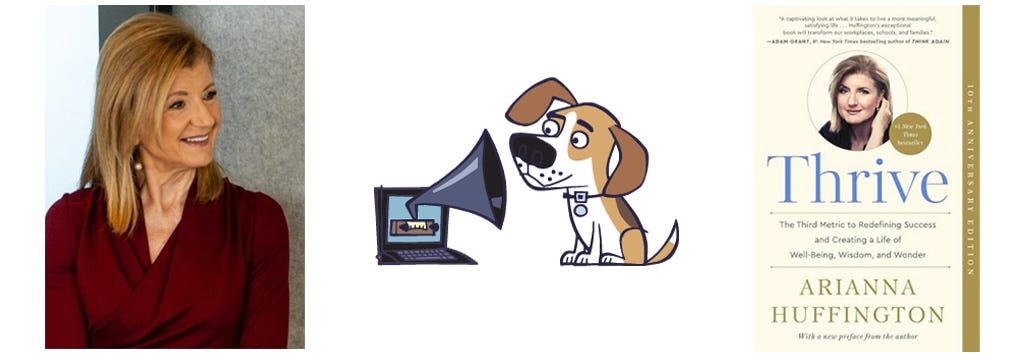
Arianna is a writer, businesswoman, and old friend from the early blog days. She co-founded The Huffington Post in 2005, and after it was acquired by AOL, she became the president and editor-in-chief of The Huffington Post Media Group. She’s currently the CEO and founder of Thrive Global, a tech company that helps people improve productivity and health outcomes. She’s also the author of 15 books, including Thrive and The Sleep Revolution.
The episode was recorded on September 14, 2026, and aired on September 18. Some money quotes from Arianna:
“But I think there is something deeper here, which is that if we disagree with someone, we don’t see them as an enemy. We see them as somebody we disagree with, maybe profoundly. I think the difference now is that politics has replaced religion. So when you disagree with someone politically, they’re a heretic. They need to be burnt at the stake. They can never be forgiven.”
“When at 17, I went to India to study comparative religion, I saw how the mystical form of every religious tradition — whether it’s Christianity, Islam, Judaism, Buddhism — is the same, which is that we all have a place of wisdom, strength, and love in us. It’s our birthright. Most of the time we’re away from it.”
“AI can be a forcing mechanism for this conversation that we have been avoiding, for this inner exploration we have been avoiding, because now we know we can no longer identify ourselves with our intelligence. Therefore, we need to ask the question, ‘Who are we?’”
“Let AI have intelligence and let humans have wisdom.”
“You remember the Maslow pyramid of the different needs, and then at the end, at the top, it was supposed to be ‘self-actualization’ — which is the way we would see our careers and our jobs. But at the end of his life, he changed the pyramid and put ‘transcendence” at the top, but hardly anyone knows it.”
Andrew: Hi there. Welcome to another Dishcast. Now leading the products — products, God — the things we give you every week under the auspices of The Weekly Dish. I had a rather nervous weekend. I will be completely frank, because we had no idea if you would all just suddenly abandon us, since I’m not giving you a column every week. And I’m taking some time to write a spiritual memoir and to think about some — and moving this podcast away — not entirely, because we’ve got to cover the world — but too more philosophical, historical, spiritual, religious, philosophical dimensions. I kind of increasingly feel that in our politics — as I’ve written about it and thought about it — there is a moment at which I don’t think the solution is political. I think the solution is spiritual. And that’s particularly true, I think, when liberal democracies end in this terribly toxic and difficult way, because the key thing we will need in the next few years, in my view, is forgiveness.
We’re going to have to forgive each other for the last 10 years, each side, if we are going to put it back together again. And we’ve got to wait for the person who can help us do that, but I think we need to get to a place outside of the frenzy of our current discourse to get the spiritual resources to put liberal democracy back together. That’s where I’m at. And I know some of you will agree and some of you disagree, and I think that’s what we’re going to talk about over the next few months.
We have some wonderful guests coming up — some of them political, some of them not. In the short term, we have Emily Eakin coming on, who’s going to talk about — we had a fantastic discussion, about the French postmodernists and what they’ve done to our culture and what they’ve done to America in a strange kind of way.
Jacob Weisberg, my old friend, a fellow intern back together in the 1980s at The New Republic. He’s written this book called Profiles in Cowardice. It’s actually — the design of it is fantastic. It’s just a parody of John F Kennedy’s (a.k.a. Arthur Schlesinger’s) Profiles in Courage, on all the people who have appeased Trump, people who didn’t have to, didn’t need to, who were members of civil society and decided that money and sucking up was more important than the independence of their institutions. So we’ll name and shame some people.
And Michael Lewis is coming in to do the opposite: to talk about some of the people he’s been discovered in the bureaucracy and in the government that have been fighting the good fight the last 10 years and just trying to do good government, despite the pressures from all sides. And Michael, as you know, can make anything into a brilliant and beautiful story. He’s an amazing person and a brilliant writer, so I’m thrilled to have him back.
But today — oh, I didn’t finish the punchline. I was nervous [over the weekend] because I was worried you were not going to listen to me anymore. And in fact, we looked at the subscriptions over the weekend and we have not seen any real change at all. You are sticking with us. And I can’t tell you what that means to us. It means I will have more space to do the things I want to do and write the things I want to write, that Chris will be able to continue to do what he does here with the window contest and with all the other features that the Dish provides every week and also his role in the Dishcast. And we can keep this going, you and us. And I can’t tell you how thrilled I am that that will work out anyway.
But this week, an old friend, someone I first discovered sitting in the bathtub listening to the radio as an English school boy — that’s how far I go back. Arianna Huffington is a writer and a businesswoman, entrepreneur. She co-founded the Huffington Post in 2005 and after it was acquired by AOL, she became the president and editor-in-chief of the Huffington Post Media Group. She’s currently the founder and CEO of Thrive Global, a tech company that helps people improve productivity and health. She’s the author of 15 books. We’ll talk about a few of them, including The Sleep Revolution, which we’ll get to, and Thrive, which is really a manifesto for what she’s currently doing.
Arianna, you look fantastic. Lovely to see you. Welcome to the Dishcast.
Arianna: Great to see you, Andrew. So many years.
Andrew: I know, I know. I first listened to you on a show in England, a very important show actually called Any Questions, which was broadcast on their equivalent of NPR, Radio 4, on a Friday evening. And it would take four panelists around the country to village halls and town halls — so it really did go all over the UK — and they would ask questions from the audience. The audience would ask questions. And this very distinctive Greek accent came on, and I was like, “Who on earth is Arianna Stasinopoúlou?” Which is how she was then introduced. So that’s how I remember. I remember thinking she was so funny and smart, and I looked forward to whenever she was on that show. Little did I know that I would go on to become good friends with her.
And Arianna, I just want to — do you remember those days when you were doing it?
Arianna: Oh, yes. And I was terrified because I was still a student at Cambridge and the only reason I was plucked out of obscurity is because I was the first foreigner to be president of the Cambridge Union. And so they had me —
Andrew: Not just the first foreigner, but the first woman actually.
Arianna: Well, I was not the first woman. Ann Mallalieu was the first one. Yes.
Andrew: Oh, okay. Forgive me.
Arianna: But being a foreigner, having an accent made me definitely an anomaly. And so I started doing Any Questions? and Face the Music. Do you remember Face the Music?
Andrew: Oh, my gosh. Yes. The English used to have these amazing radio shows of discussion of people. I remember they would be at a level of knowledge and of wit that you just can’t imagine hearing today on any public broadcast.
But let’s go back a little bit to where you started. Tell me about — you grew up in Athens. Tell me about your parents. What were they like? What influence did they have on you?
Arianna: A huge influence, especially my mother. My father was a journalist who during the German occupation of Greece published an underground newspaper, was arrested by the Germans, spent the war in a concentration camp, met my mother while he was recovering from the camp in a sanatorium and she was recovering from TB.
Andrew: Good Lord. In the same sanatorium?
Arianna: Yes. So they told them that she could never have children. She promptly got pregnant with me before she was married and decided to keep the baby, which was pretty amazing at the time. And they got married —
Andrew: Why amazing at the time? Because she was out of wedlock?
Arianna: Because it was so many years ago and she was living in Greece and having a child out of wedlock was not the norm, although my father did marry her.
Andrew: You were conceived in the sanatorium?
