

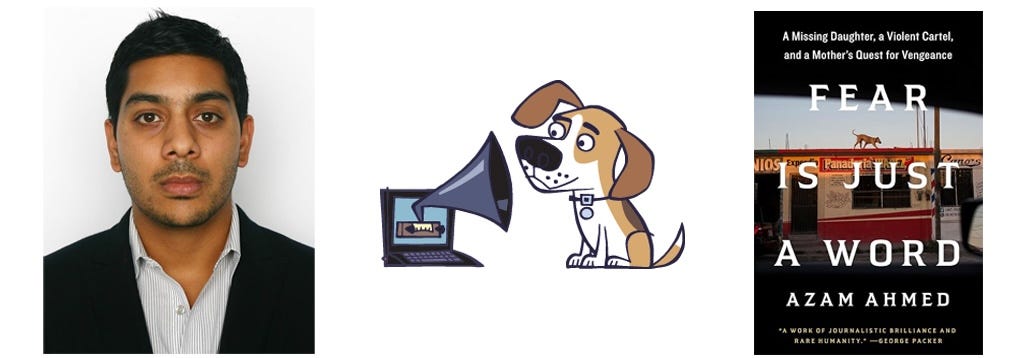
Azam is an international investigative reporter for the New York Times. He used to be the Times bureau chief in Afghanistan, as well as Mexico, Central America, and the Caribbean. He won a Pulitzer last year for his work on the US intervention in Afghanistan, among other awards. He’s also the author of Fear Is Just A Word: A Missing Daughter, a Violent Cartel, and a Mother’s Quest for Vengeance. I discovered him simply by reading the paper and noticing an extraordinary ability to ferret out the truth. In conversation, Azam did not disappoint.
The episode was recorded on September 1, 2026, and aired on September 11. Some money quotes from Azam:
“One of the most interesting and compelling questions that had not been answered was how did history’s most sophisticated army lose to a bunch of villagers in flip-flops with ancient rifles?”
“We covered a 20-year war covering just one side, and that side was propagandizing ad nauseam, bullshitting us all the time, lying about things, fooling themselves, probably believing half of their bullshit.”
“With synthetic drugs, you can liquefy and essentially soak paper in these drugs, and then if you smoke them, you get the effect. … They’ve basically turned the most ubiquitous substance in the world into drugs.”
“We used to always fucking tell kids, ‘Oh, don’t do drugs, you’ll die.’ … We wasted all that bullshit when it wasn’t going to kill you, and now those words just don’t resound as much. … [Today] it really is one faulty Adderall tablet to study and you could wind up hospitalized and dead.”
“The West Bank didn’t have anything to do with October 7th, but violence escalated there, settler attacks escalated there, the IDF became much more aggressive there…. And now you’re seeing settlers raid and rampage in an almost medieval way.”
“You could bookend Israel/Palestine with US/Afghanistan — a horrific, terrifying, traumatizing terrorist attack that then elicits such a staggeringly big and violent response, that is seismic in the way that it changes the world we live in.”
“When I read a novel, I feel so much more gratified about the human experience, so much more seen — the complexity, the nuance, the character development, the charity that a great writer has for their characters, no matter how bad they are. It can be really hard to feel and find that in nonfiction — and especially today, when everything feels so fucking stark and heavy.”
Andrew: Hi there. Welcome to the new season of The Dishcast. I think of seasons that way because I like a good summer break, as you all know, and I’m really grateful to you all for allowing us to have those weeks away from the world. I did my usual. I went out to the dunes, the tidal pools, I biked. I sat in the pools. I smoked a bunch of weed. I hung out with friends, and I played a lot with my dog, and took him all over the place and just stayed here and did not really read the papers and stayed off, for the most part, social media.
And I have to say, it feels great at the end of it. I didn’t realize — well, I do realize — but I think those of us that do this for a living, that have been writing and thinking about our politics and culture, especially in the era of Trump, if you do that for a decade, eventually your brain begins to really calcify in ways that are not pleasant.
And I think having — and I’ll say this as plainly as I can — having someone with mental illness as your president kind of spreads. It’s like every time you have a mentally ill person in a family, everyone in the family becomes a little mentally ill, unfortunately. I don’t mean this to stigmatize. I’ve been in that family myself. I know what this is. And it’s important to get some boundary, some place to go where he and the atmosphere — both he and the woke in many ways, on the other side, have created. And I’m so grateful for you guys allowing me to have those three weeks away and to decompress and to come back in the fall with more energy and a little bit calmer, I think. Perspective is so important. The cliche “touch grass” is a good one, but I just jump into a pool, look at the sky, all the rest of it.
So after my little hippie sermon, we have some amazing guests coming up, and I want to thank you again for subscribing. Emily Eakin is coming on soon to talk about French postmodernism. We’re going to go over all those people that have helped create our modern world. Jake Weisberg — my old, old, old friend — has written a terrific polemic against all of those who have appeased Donald Trump. It’s called Profiles in Cowardice, and it’s coming out this month. And Arianna Huffington is coming on, and we’re going to talk about life, and love, and the soul, and how you survive in an internet era and keep your sensibility and your equanimity intact.
But today, someone I’ve come across simply by reading the pieces, and I read a few of them and was like, “God, that was good.” And then I looked to see who was the reporter. And then over the last couple years, even more amazing stuff. I posted a note the other day on Notes pointing to a terrific piece about new drugs in Estonia.
Anyway, Azam Ahmed is an international investigative reporter for The New York Times now. He used to be the Times Bureau Chief in Afghanistan as well as Mexico, Central America, and the Caribbean. He won a Pulitzer last year for work on the US intervention in Afghanistan. He’s also the author of Fear Is Just a Word: A Missing Daughter, a Violent Cartel, and a Mother’s Quest for Vengeance. And he’s won the George Polk Award. He won the Mike Kelly Award, the James Foley Medill Medal for Courage in Journalism, an Overseas Press Club award.
I knew Mike Kelly pretty well, so it’s good to know you’ve got his prize. He was the kind of crazy-ass motherfucker that would go into any place, however dangerous, and was able just to write what he saw in a way that was really amazing. I was lucky enough; I edited his pieces coming in from the first Gulf War — no, no, from the Iraq War, 2003. And the prose came in just staggeringly good. And he’s one of those people like Michael Lewis; you don’t really need to edit very much; you just need to get out of the way. But anyway, that attention to detail, that eye, that’s what my guest today has, I think. And I hope you can look him up, look up the pieces he’d been writing, look up that really terrific book. Azam, thank you so much for coming on The Dishcast.
Azam: Thank you so much for having me.
Andrew: You’re welcome. Let me ask you first of all, who were your parents and how did they bring you up and where did they bring you up?
Azam: My parents both were born in Pakistan and they migrated to the US not too long before I was born. I’m the third of four kids. And they raised me in Danville, Virginia, which is a small town right on the border with North Carolina, kind of dead center of Virginia.
Andrew: What did they do?
