

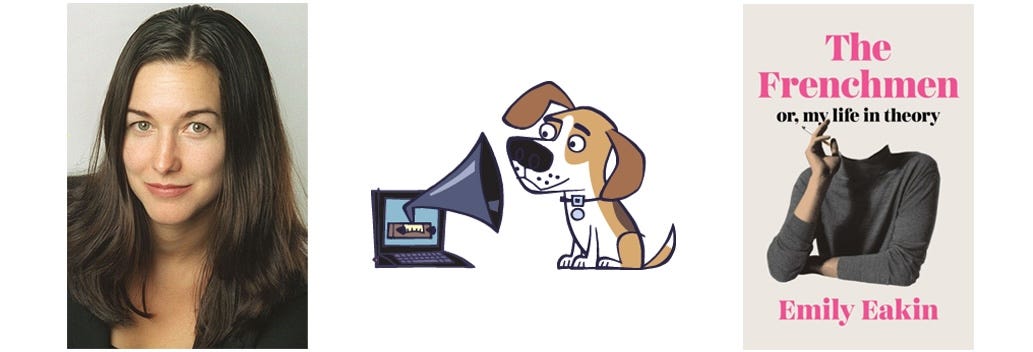
Emily is a senior editor at the New York Times Book Review. She’s also worked as a senior editor at The New Yorker, an ideas reporter for the NYT, a fashion features writer at Vogue, and a deputy editor of Lingua Franca magazine. Her new book is The Frenchmen: Or, My Life in Theory.
The episode was recorded on September 8, 2026, and aired on October 2. Some money quotes from Emily:
“That’s why universalist ideas that we’ve inherited from the Enlightenment — ideas about justice and equality — are constantly being contested, right? We can’t as a species seem to agree on what these concepts mean. And the takeaway of these French thinkers is really to understand why these concepts should be contested, because we have no objective foundation on which to erect a single truth.”
“The idea that language is a sort of scrim over the world doesn’t mean the world doesn’t exist. It just means we are doomed to talk about it in words. It’s the only option we have. And what does that mean? Well, that these French thinkers wanted to give that paradox a kind of very rigorous scrutiny.”
“These men come out of a left-wing milieu. The critique of literature and language is a critique of bourgeois ideology. This is what is being exposed. This is where language is complicit with power in insidious ways. And that’s what they were about.”
“The charge of nihilism is somewhat fair to be put at the doorstep of the French thinkers, but not wholesale nihilism, because they were really looking at the Western philosophical tradition for metaphysical missteps, if you will.”
“I’m really struck by what you’re saying, and I had not really stopped to think about the Straussian cult existing simultaneously with the, let’s say, post-structuralist cult of which I was an ambivalent, fascinated, peripheral part of.”
“There’s a perception on the right that these DEI movements promulgated by HR managers are part of an oppressive liberalism that can be named and resisted with the aid of Foucault. And so what’s interesting to me is Foucault — a man of the left — has now been embraced by the right, which is a sign of where power’s hegemonic force is perceived to be, right? So wherever power feels oppressive, then Foucault becomes an ally of the resisting population. It’s very interesting.”
“For me, the antidote [to postmodern theory] was journalism, which is a practice, a language-based practice, that holds that language corresponds to something called the real world and represents people and ideas and things that happen or exist in that world. And my first job in journalism was not coincidentally as a fact-checker.”
Andrew: Hi there. Welcome to our new season of 2026. We’re covering all topics under the sun. I want to thank you for subscribing. Really, deeply, deeply grateful — we need you more than ever. If you haven’t subscribed, please do. We don’t have any ads; we have no sponsorships; it’s a really pure podcast. This is just to you, paid by you, no other people involved whatsoever. I will not try and sell you a lawnmower in the next hour-and-a-half, I promise you. So, please do.
We have some really fantastic guests coming up. We’re moving a little bit away this season from contemporary events, partly because I’m sick of them. And I think I’ve said all I really have to say about them. And we’ll pick up again with the political day blow-by-blow in January of ‘28 when we actually have a couple of candidates to talk about, we have some positive proposals to assess, and we’ll get back to it then. But I think a little detour to get a little perspective on where we are and where we’re going is what we’re trying to do with this season of The Dishcast.
And in that respect, my guest today has written a book about the most influential school of thought, really, in the West since the Second World War, a school of thought that started in France, migrated to America, and became something somewhat different. And the writers involved in this are really extraordinarily difficult to read. And so, one is rather thrilled for the idea of someone else will read them for us and help explain them to us. And that’s what Emily Eakin has done.
She’s a senior editor of The New York Times Book Review. She’s worked as a senior editor at The New Yorker, an ideas reporter for The New York Times, a fashion features writer at Vogue, and a deputy editor at Lingua Franca magazine. A new book, this book is called The Frenchmen — which is a great title — Or, My Life in Theory.
Welcome, bienvenue.
Emily: Thank you so much, Andrew.
Andrew: Emily, what a terrific book this was. I mean, it’s a handful and a lot of complicated ideas to deal with. So let me ask you first of all: tell me about your parents. What did they do for a living, and how did they affect your trajectory in life, do you think?
Emily: Absolutely, this is a good way in. I was primed to fall for French theory for many reasons, but a central one being that I come from a family of Francophiles. My father was a professor of American literature at Indiana University in Bloomington, Indiana. He’s retired now, but he was and is a lifelong Francophile. In fact, I have a photo of him early on in my book, sitting in his Parisian garret in 1960 in full existentialist regalia, the black turtleneck and the black framed glasses, holding an issue of Combat, the leftist newspaper, with the shocked headline [about] the sudden, unexpected death of Albert Camus.
Andrew: And Camus, of course, was a serious contributor to Combat in the Second World War.
Emily: Absolutely, absolutely. And he was part of the whole existentialist movement until he had a falling out with Jean-Paul Sartre. And so I inherited this love of French and France, in part because every time my father had a sabbatical, he would take us to Europe, twice to Paris. And so some of my earliest memories are of living in Paris, actually during the structuralist heyday in the ‘70s, being in nursery school at the maternelle [kindergarten], and my mother being late to pick me up because Claude Levi-Strauss’ lecture had run over — Claude Levi-Strauss, of course, being the father of structuralist thought, the man who brought structuralist theory to France. My parents were all agog reading all the structuralist books in French. And so that really primed me, I think, to be receptive to French theory.
Andrew: Well, that’s a quite extraordinary story that you basically had no choice but to get through these people. If you’re going to shake off your mom and dad at some point, you have to go through what your mom and dad were reading, even in the original French. And by the way, of course, I think some of these books do read better in the French. There’s a kind of beauty and clarity to the French language, a structure to it that is much more — it makes some of these works more accessible, to me anyway.
Emily: I think that’s absolutely true. And of course, having had this exposure to French early on, I continued to take French classes and was interested in French. In my senior year, I spent in Rennes in Brittany on a program, partly just to get out of landlocked Indiana. I had enough of the Midwest and the small town, and but when I got to college, I took French literature classes, and French departments were the portal through which theory entered American campuses, at least initially.
Andrew: I did French literature as well. I did, but my special subjects were Montaigne and Pascal. So, slightly different.
Emily: You were a more classically oriented student. The revelation for me, the class that just blew my mind was a class — I think it was the spring of my sophomore year — on experimental French literature, 20th century. We read Georges Bataille’s pornographic novella, Histoire de l’œil — The Story of the Eye — which Susan Sontag says is one of the best pornographic novels of the 20th century. We read Marguerita Ross, we read Alain Robbe-Grillet, Natalie Sorot, Monique Wittig — kind of a militant lesbian novelist. It was all very exciting and new, and it went hand-in-hand with theory.
Andrew: What exactly blew your mind in that class? What was the idea that struck you as mind-blowing?
