


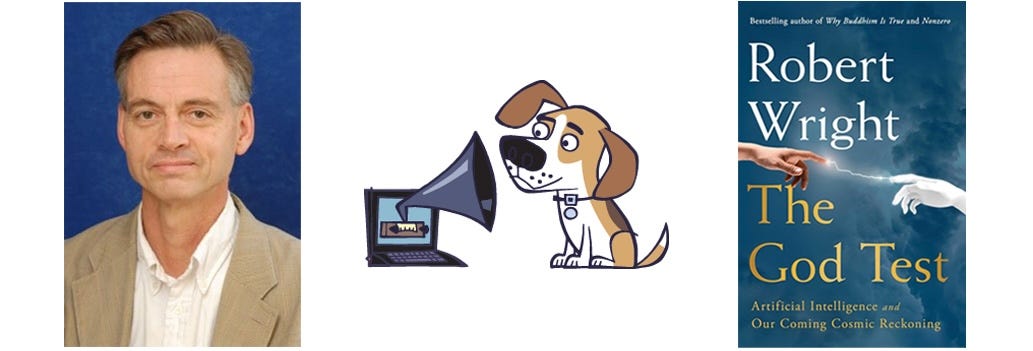
Bob is a journalist and the author of many books, including The Moral Animal, Nonzero, The Evolution of God, and Why Buddhism Is True. He’s written for countless magazines, including The New Republic, where he co-wrote the TRB column with Mickey Kaus. They also co-founded Bloggingheads TV, and Bob taught in the psych department at Penn and the religion department at Princeton. Today you can find him on Substack at the NonZero Newsletter, and his new book is The God Test: Artificial Intelligence and Our Coming Cosmic Reckoning. It’s a doozy of an introduction to the subject — with all of Bob’s signature clarity, wit, and sense of moral purpose.
An auto-transcript is available above (just click “Transcript” while logged into Substack). For two clips of the episode — how AI flatters its users, and the rapidly converging threats from AI — head to our YouTube page.
Other topics: Bob’s reporting on AI in the early 1980s; Geoffrey Hinton — “the godfather of AI” — warning us about AI; “doomer-in-chief” Eliezer Yudkowsky; Bob’s own evolution on AI; the Tree of Knowledge; how AI is a more challenging global issue than nukes; the need for international regulation; the noosphere, our “global brain” — and its author, the visionary Christian, Teilhard de Chardin; neural networks; ChatGPT; Musk and self-driving cars; BF Skinner; philosopher John Searle; olfactory AI; virtual reality; AI designing drugs to induce spirituality; Anthropic’s Dario Amodei; Sam Altman calling Trump an NPC; AI stoking conspiracies; Leo’s encyclical; cognitive empathy; the Iran War; China vs Taiwan; kids befriending AI agents; Hal in 2001; the movie Her; silicon neurons that evolve; AI threatening the human need to be needed; job losses; scams; electoral risks; populism and tribalism; how is AI a continuation of human evolution; and the many positive potentials of AI.
Browse the Dishcast archive for an episode you might enjoy. Coming up: John Gray on Trump’s new world, Stephen Grosz on the struggles of love, David Thomson on cinema history, John O’Sullivan on conservatism, Robby George on all our disagreements, and Megan McArdle on pretty much anything. Please send any guest recs, dissents, and other comments to dish@andrewsullivan.com.
From a fan of last week’s pod on privacy in a liberal democracy:
I had been looking forward to your interview with Tiffany Jenkins and really enjoyed it. The older I get, the more I come to appreciate the importance of the distinction between the public and private self. When I was younger, for instance, I used to scoff at traditional older women who would put on nice clothes and make-up before they would dream of being seen in public. Why not just be themselves, I thought? Now, I see it as their way of showing courtesy to the public.
Apropos of your discussion on manners, I thought you and my fellow readers might enjoy this essay about the late Supreme Court justice John Paul Stevens by one of his former law clerks. It’s a beautiful explanation of the deep morality of good manners and formal courtesy.
Another writes, “Good episode, intelligent and informative, and gives an interesting lens to look at history.” Hey, that’s what we aim for. Another clip touches on “Sodomites’ Walk” in London, an ancient glimpse of gay life:
A guest rec for the Dishcast:
Like you, I’m a UK expat living now 30+ years on the West Coast, and I like it when you turn your focus to the UK. Your fellow Substacker Ed West does a good job of exposing the country’s ongoing problems. I suspect his readership is much smaller than yours, and I bet your American readers and listeners find this topic just as significant as I do. So why not cover this topic more often and have Ed West on the Dishcast?
He’s fantastic. Good idea. Another rec:
Long-time subscriber, but this is the first-time I’ve written in. How’s this as a guest recommendation for the Dishcast: Peter Hitchens. For some reason I can easily imagine you rolling your eyes at this one, but please hear me out.
While I can’t envision the two of you as the most obvious mates — the term “chalk and cheese” comes to mind — the more I think about it, you seem to share many things in common: your Christian faith, a love of the English language, a deep and abiding love of England and the English countryside, and a certain sense of bewilderment at what England has become.
Perhaps more importantly, how many people have been more prescient (and maybe more hopeless) in their diagnoses of the UK over the past couple decades than Peter Hitchens? All one has to do is watch his “infamous” appearance on Question Time in 2013 to see that he was well ahead of the curve on where Britain was headed, especially starting at the 49:55 mark:
Every time I see that exchange in my feed, I wonder about the folks in the audience who laughed at Hitchens. I wonder how many of them would laugh today. (But let’s face it, watching Liz Truss argue that “Britain’s best days are in front of it” is comedy gold.)
Here are some topics you could discuss with him: the state of British policing, green energy, the role and nature of the BBC, the education system in Britain, the conservative party (or lack thereof). His answers are always interesting and well-reasoned, if not always convincing. He’s also been saying that Britain is finished for more than two decades, and that the smartest thing young people could do would be to leave. Even his understanding of Russia’s war in Ukraine is far deeper and more nuanced than most pundits.
Anyway, just a suggestion. I’m certain that it would be a fascinating conversation.
He’s great fun. I debated him decades ago on marriage in Idaho, of all places. But gotta limit some of the Brit influence here, even though you all love the accent.
Here’s a reader on my column “Is AI The Anti-Christ?”
Overall I like and agree with your column, but I wish you would dial back on the “AI can’t be stopped” argument. I agree it’s unlikely to be stopped, but there is no reason in principle that we couldn’t negotiate with China and pause the AI race — and every reason both in principle and in practice to actually do it. Saying that we can’t do it simply makes it harder, since what is lacking is political will, largely based in the theory that it’s impossible. It’s not like most people like this stuff, and putting the politics on a pause would be great if anyone gave it a try.
As for the “but China!” angle, I can only beg that you to read Scott Alexander on the subject.
We discuss this on the podcast this week. I agree it’s possible. Just very very unlikely. On last week’s column, another writes:
Comparing our debacle in Iran to the 1956 Suez Crisis has some merit, but it ignores an important difference: Britain and France were stymied in Suez when America — their more powerful ally — intervened and forced them to withdraw by, among other things, threatening to undercut the British pound. In today’s Iran war we were defeated by Iran — a weaker power by all measurements. No greater force intervened apart from economic reality. This would be akin to Egypt having defeated the UK and France during the Suez Crisis. It makes our debacle even more humiliating, and it’s a potent illustration of deeply flawed leadership and declining power.
It would be slightly encouraging if only one Trump sycophant had forcibly suggested during the lead-up to war that air power alone has never, ever resulted in regime change since the Wright brothers. Trump, flush with the Venezuela success, would have rejected it, but at least there would be hope that someone in this administration was minimally competent.
The CIA did tell him the Netanyahu scenario was “farcical.” Here’s a dissent:
I was deeply unsettled after reading your column.


