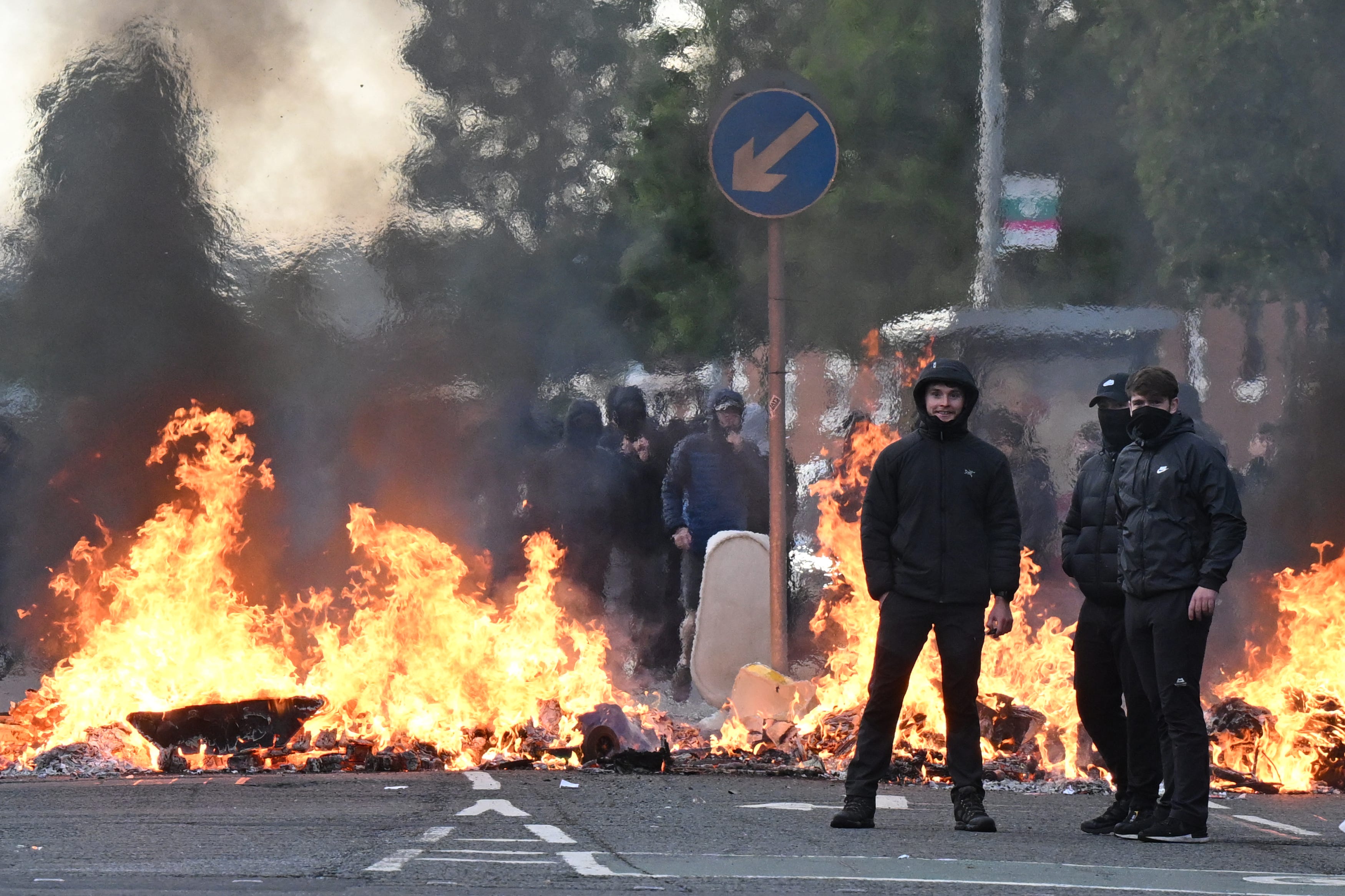
Youths gather in front of a burning barricade in Belfast, Northern Ireland, on June 9. (Charles McQuillan/Getty Images)
The videos are hard to watch. In one, a Sudanese asylum seeker, in the UK since 2023, straddles a local man in Belfast on the street this week and seems to try to behead him with a knife, holding his victim’s head up, slashing at his neck and face, as passersby try to stop him — and one finally did, with a hurling stick. The victim is in the hospital with serious wounds, including the loss of his left eye.
The other video is police bodycam footage of another stabbing, this time by a Sikh man, Vickrum Digwa, of a young white Brit, Henry Nowak. This time, the UK-born killer immediately called his family after the stabbing, and his brother called the cops to report a hate crime againstDigwa by Nowak, while his mother hid the murder weapon (which was a huge Sikh ceremonial knife — a sign of true multiculturalism in a country where carrying knives in public is generally illegal). The cops arrived and instantly put the white guy in cuffs, even as he kept insisting he had been stabbed and couldn’t breathe. “You’ve been stabbed? Whereabouts? Don’t think you have, mate,” says one of the cops, as Nowak bled out and died. He was 18.
It would be foolish to draw huge conclusions from these two separate, unrelated, unique violent crimes. The crime angle is particularly off-base. Violent crime in the UK last year amounted to 1.1 million incidents, down about 75 percent from 1995, when mass migration had yet to really take off. London just recorded the lowest murder rate in a decade. The killer of Nowak was British born. (It’s worth noting, however, that the number of Sudanese nationals now in the UK prison population has risen by 151 percent since 2021; and that some nationalities common among asylum seekers do have higher rates of criminality.)
In any case, there is absolutely no defense of the intense, often baldly racist, riots that broke out in Belfast after the release of the footage of both attacks. They are as indefensible as the BLM riots after the death of George Floyd. Violence is never, ever the right response to police failure, or a hideous crime.
But both incidents in the UK spawned the violence because they symbolized three underlying social and political crises that desperately need addressing.
The first is simply absorbing the massive wave of migrants from the developing world over the past several years. The elites tell you now that the problem is in the past — and it is. But immigration last year was still more than 800,000 people — 77 percent non-European and the previous massive wave is not going anywhere. Worse: in a multicultural era, assimilation into Englishness is optional and the numbers are so large that groups can exist as functioning parallel societies in some areas, with minimal outside contact. It’s also true that, in some cases, refugees bring the cultures and traumas of their violent and misogynist native lands with them. The scale and the pace of this demographic change would strain any society’s cohesion and stability.
The second is the attitude of the elites — Tory and Labour — to the impact of this change. They’ve essentially dismissed it. And for decades, any complaint about immigration was instantly demonized as racist, and cancellation was automatic. The full, woke, mass-migration regime came into force even under the Tories. Far too often, the cops were told the worst offense they can commit is racial prejudice or transphobia. They knock on doors and arrest people for mean tweets — Lucy Connolly was sentenced to 31 months — and turn a blind eye to organized rape gangs of Pakistani Brits because tackling that crime could be deemed ... racist. To many of the natives, seeing their country transformed, that can feel like adding insult to injury.
And the cops who showed up to Nowak were right out of woke central casting. Believing a liar claiming a hate crime because of his race, they immediately arrested the white victim. As riots erupted after the verdict — a correct and punitive life sentence for Digwa — the elites again rallied to insist that justice was done (it was) and only the far right remained the problem. But the double standards are pretty blatant. Keir Starmer knelt for George Floyd, who died in the hands of racist cops in another country. But not for Henry Nowak, who died in the hands of racist cops in his own country.
When you zoom out from these awful incidents, things look worse, not better. Mass migration without assimilation is still in place; opposition is still stigmatized as racist; and the elite “airport lounge” project remains intact. Only 37 percent of Londoners are “white British” now, according to the 2021 Census, and only 33 percent of Leicester, 43 percent of Birmingham, and 49 percent of Manchester. By 2063, white British will make up less than 50 percent of the whole population, compared with 95 percent in 1983. And you wonder why many older Brits don’t recognize the country they grew up in.
America — a vast continent with 400 years of immigration experience — is having trouble with a foreign-born population that hit a record high of 15.8 percent last year. The UK — a tiny, overcrowded island with barely 50 years of experience with mass migration — is nearly as high at 15.2 percent; Germany is at 19.1; and Switzerland is a staggering 32 percent.
Who cares? Certainly no self-respecting member of the ruling class. Isn’t it better to have a much richer diversity of cultures, languages, and religions anyway? Do you remember how awful British food was? London is so much more fun than it was 30 years ago. I can predict many responses to this column along those lines. And I personally love that kind of diversity. I get it. But I chose it by moving. And that matters.
There is, after all, a thing called human nature and a virtue called prudence. Most people don’t like their home being changed radically without their consent. And many people in Europe feel they were never really given a choice, as mass migration became a shibboleth on both the establishment left and right. Lefties understand this about, say, gentrification or colonization of the developing world by the West — but not when it’s about the developing world coming back to transform the West demographically. In fact, many delight in it as colonialism’s revenge.
But no one alive today colonized anyone. And human nature is universal. This massive and fast a change after a thousand years of remarkable demographic homogeneity is bound to provoke revolt. The question is why no one dared to make that obvious point before it was too late — and do something to prevent or moderate it. And the answer is that no one had the balls.
Enoch Powell famously broke the silence in 1968 and spent the rest of his life in the political wilderness. Thatcher was elected partly on anti-immigrant feeling. But Brexit was the first real eruption. It’s telling that it didn’t happen in a general election, because both parties were equally pro-immigration. Only a referendum could break the elite grip. The yes vote offered the Tories a chance to end mass migration, and if they’d co-opted the hard right, answered its legitimate grievances, and kept the center intact, they could have been in power indefinitely.
But then Theresa May fumbled the ball, taking forever to get Brexit through parliament, fueling populist suspicion of elite backsliding. Then Boris broke through and got Brexit done — only to turn around and launch a massive new migration wave, entirely from outside Europe. “Global Britain” and all that cringe. You can imagine the populist fury after that. Hence the Tories now close to extinction because of apparent betrayal; and Labour dead-in-the-water in government.
Put into that atmosphere of intensifying frustration a couple of atypical but inflammatory incidents caught on video, throw in a dose of social media, and the streets of Belfast blew up like old times. When a referendum doesn’t work; when the PM betrays you; and when Labour now treats you like distasteful deplorables: you can see why some elements exploded, however inexcusably.
A scholar of civil wars, David Betz, argues that what’s emerging in the UK — and across Europe — are countries containing parallel ethnic and religious communities, alongside plummeting confidence in the police, suspicion of democratic politics, low economic growth, collapsing social trust, and an acute housing shortage. That’s a recipe for guerrilla-style violence in a simmering, low-level civil war on similar red-blue lines as over here.
And what was unnerving about the Belfast riots is that they looked way more professional than others before them. You could see well-organized gangs of masked men, with a strategy, calculation, and anonymity. Northern Ireland has — ahem — a history of guerrilla warfare, so that may explain part of it: it’s a collective legacy of the Troubles. But those troubles may be coming back to Britain for a different reason. On a larger scale. And spread much farther than Belfast.
(Note to readers: This is an excerpt of The Weekly Dish. If you’re already a paid subscriber, click here to read the full version. This week’s issue also includes: a pod debate with Daniel McCarthy over Trump and conservatism; listener dissents over Israel and Iran; reader dissents and other comments on the LBG/TQ+ rift; eight notable quotes from the week in news; 18 pieces on Substack on a variety of topics; a Mental Health Break of fishy behavior; a stunning urban window from Albania; and, of course, the results of the View From Your Window contest — with a new challenge. Subscribe for the full Dish experience!)
From a new subscriber:
I’ve been a freebie reader for a while. I appreciate the generous serving of content you provide at that level, but I want to use your work more extensively as a source for my own opinion writing, so I’m ponying up the dough for a subscription.
New On The Dishcast: Daniel McCarthy
Daniel, previously the editor-at-large at The American Conservative, is currently the editor of Modern Age, a conservative academic quarterly journal. He’s also a Distinguished Fellow in Conservative Thought at the Heritage Foundation and a columnist for The Spectator — and one of the few Trump supporters allowed to write op-eds for the NYT. I wanted to engage the most intelligent defense of Trump I could find. And Dan did not disappoint. But you be the judge.
Listen to the episode here. There you can find two clips of our convo — on Trump as a corrective to the liberal establishment, and questioning how revolutionary the American Revolution really was. That link also takes you to dissents and other comments on last week’s pod with Ben Rhodes. We also hear from a ton of readers on Israel, AI, and the LBG/TQ rift — with my responses throughout.
Browse the Dishcast archive for an episode you might enjoy. Coming up: Tiffany Jenkins on privacy in a liberal democracy, John Gray on Trump’s new world, Bob Wright on the evolutionary force of AI, Stephen Grosz on the struggles of love, David Thomson on cinema history, James Verini on Ukraine, John O’Sullivan on Hungary, and Robby George on all our disagreements. Please send any guest recs, dissents, and other comments to dish@andrewsullivan.com.
“I want every trans person to have every civil right a gay person has — and they do!” Have you not followed the trans-in-the-military issue, or was gays in the military/DADT not actually a thing a short while ago? Sure, an appellate court panel has sided with trans soldiers currently in the military, but it did not extend the decision to those wanting to join. So no, we don’t have the same rights as gays.
That’s correct. I support trans people in the military, but there are some medical issues that make it a little different than gay men and lesbians serving. Still, you’re right. It is, of course, barely mentioned by trans activists as well.
Another dissent:
I’ve always opposed same-sex marriage because I feel certain that it’s vital for children to have a mother and father. (For example, the idea that a teenage girl going through puberty isn’t missing anything by having two dads instead of a mom is very difficult for me to even take seriously.) But your column touches upon the second biggest reason I’ve always opposed it: the current radicalism has long been foreseeable.
Although I was starting to find a lot of your arguments persuasive all the way back in 2005 or so, it was around that time that I started seeing the illiberal left take over the rights movement. I certainly won’t pretend that I foresaw things heading exactly where they are today, but directionally, all the indicators were emerging: the brooking of no dissent, the constantly shifting goalposts, the all-or-nothing posture, an endless stream of phony new outrages.
I, of course, know you always wanted a movement based on persuasion and that allowed for disagreement. But you’re one person. I can’t think of any modern civil rights movement that will tolerate anything other than full-throated endorsement of its agenda, and one that doesn’t need to turn over every rock to find every last dissident. Even a view as milquetoast as mine — that we should teach children heteronormativity when they’re very young, to allow them to grasp the basics, before we start explaining that there can be different types of families — was never going to be accepted. That was inevitable.
I’ve long thought that you have something of a blind spot when it comes to the controversial liberal causes (with mass immigration and multiculturalism being admirable exceptions). Not to embarrass you, but we all know that you have a genius IQ, a deep reverence for liberalism, and an otherworldly knowledge of what civilizations require to remain stable. But very few people have any one of those things, let alone all three.
You may have wanted a rights movement that was able to quit when it was ahead, accept that there would always be something viewed as slightly unusual about a minority orientation, and perhaps even be willing to concede that the majority had something at least marginally preferential to offer the next generation. And in a country full of 340 million Andrew Sullivans or people who hang on his every word, I have no doubt that it would work.
But in reality, we have a country where 15% of people think vaccines contain microchips and large numbers get their news and information from social media influencers who can barely spell their own names. It seemed inescapable that the herd was bound to follow in some different, and unfortunate, direction.
That’s a very potent argument. And I’d be lying if many of its themes had not been buzzing around my own head for a while now.
Was it ever possible to bring a liberal settlement for a contentious social issue? I still believe so — but the word “liberal” matters. A liberal democracy can allow for pluralism, can accept compromise — like civil marriage for gays alongside protection for religious freedom for those who dissent. An illiberal democracy will find this intolerable, as the hard right will seek to end marriage rights and the hard left to turn gays into a vanguard of their gender revolution. And the decade since marriage won in 2015 has been one the least liberal of my lifetime.
So the survival of marriage equality is intrinsically linked, in my view, to the survival of liberal democracy. The populist right is one enemy. But the queer left is just as ruthless in suppressing pluralism. So our task is two-fold: defend marriage and defend liberalism in the classical sense. That’s what we’re trying to do here at the Dish. Help us keep the flame alive by subscribing. Its time will come again if we hang in. And the American public still backs gay marriage by a big margin. We just have to stop the extremists on both sides from threatening it.
Many more dissents — on this topic and others — are over on the pod page. Please keep the criticism coming: dish@andrewsullivan.com. And follow more Dish debate in my Notes feed.
This is a feature in the paid version of the Dish spotlighting about 20 of our favorite pieces from other Substackers every week. This week’s selection covers subjects such as war crimes in Iran, ratfucking Platner, and assisted suicide. Examples:
Cathy Reisenwitz calls heteropessimism an “annoying affectation” of the elite. Evan Marc Katz has tips for the pessimists trying to date.
According to Daniel Scheffler, “the first travel writer” — Hadrian — “was gay, grieving, and running an empire.”
Here’s a list of the substacks we recommend in general — call it a blogroll. If you have any suggestions for “In the ‘Stacks,” especially ones from emerging writers, please let us know: dish@andrewsullivan.com.
The View From Your Window Contest
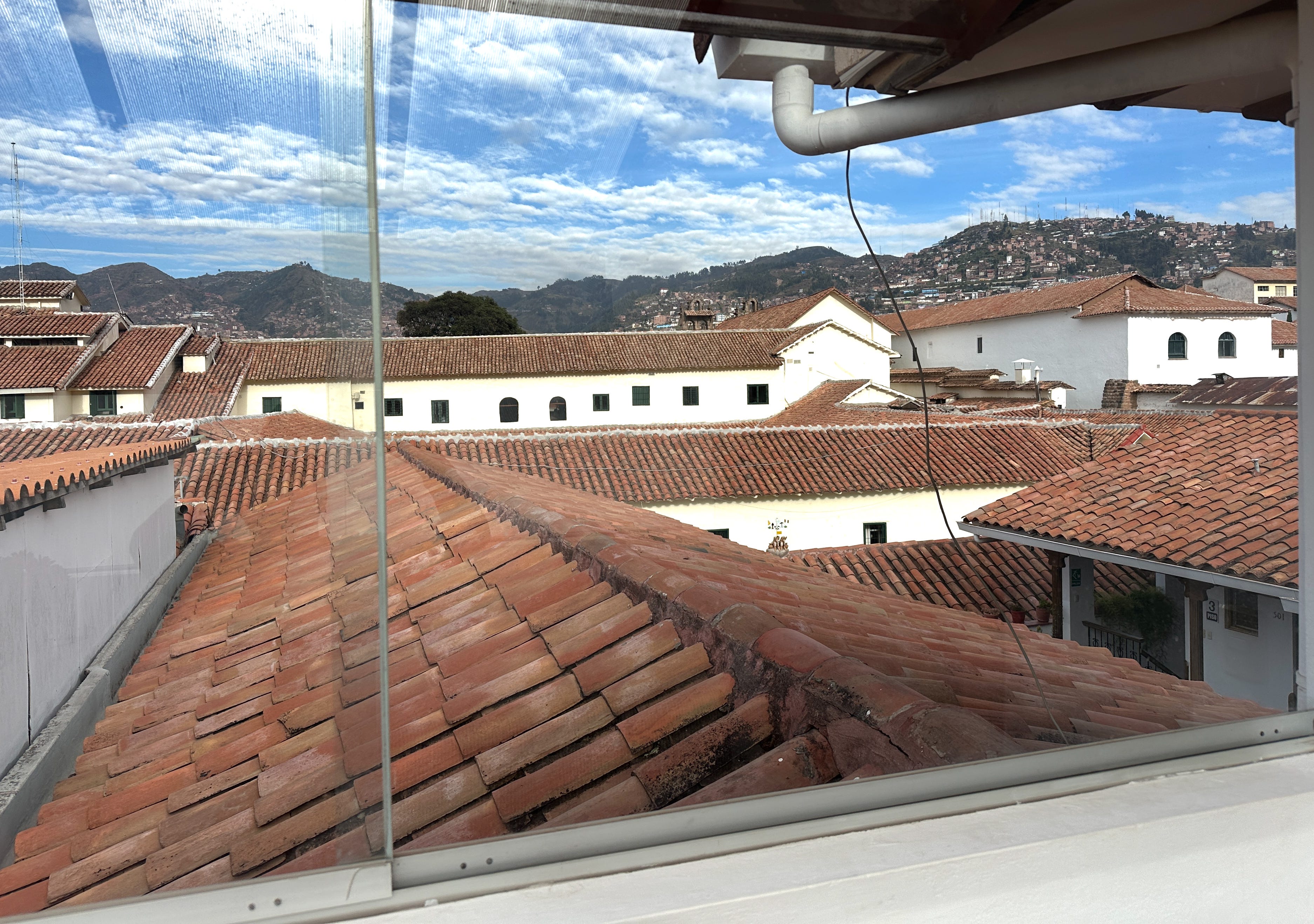
Where do you think it’s located? Email your guess to contest@andrewsullivan.com. Please put the location — city and/or state first, then country — in the subject line. Proximity counts if no one gets the exact spot. Bonus points for fun facts and stories. The deadline for entries is Wednesday at 11.59 pm (PST). The winner gets the choice of a VFYW book or two annual Dish subscriptions. If you are not a subscriber, please indicate that in your entry and we will give you a free month subscription. Contest archive is here. Happy sleuthing!
The results for this week’s window are coming in a separate email to paid subscribers later today. Below is last week’s food report from our resident chef:
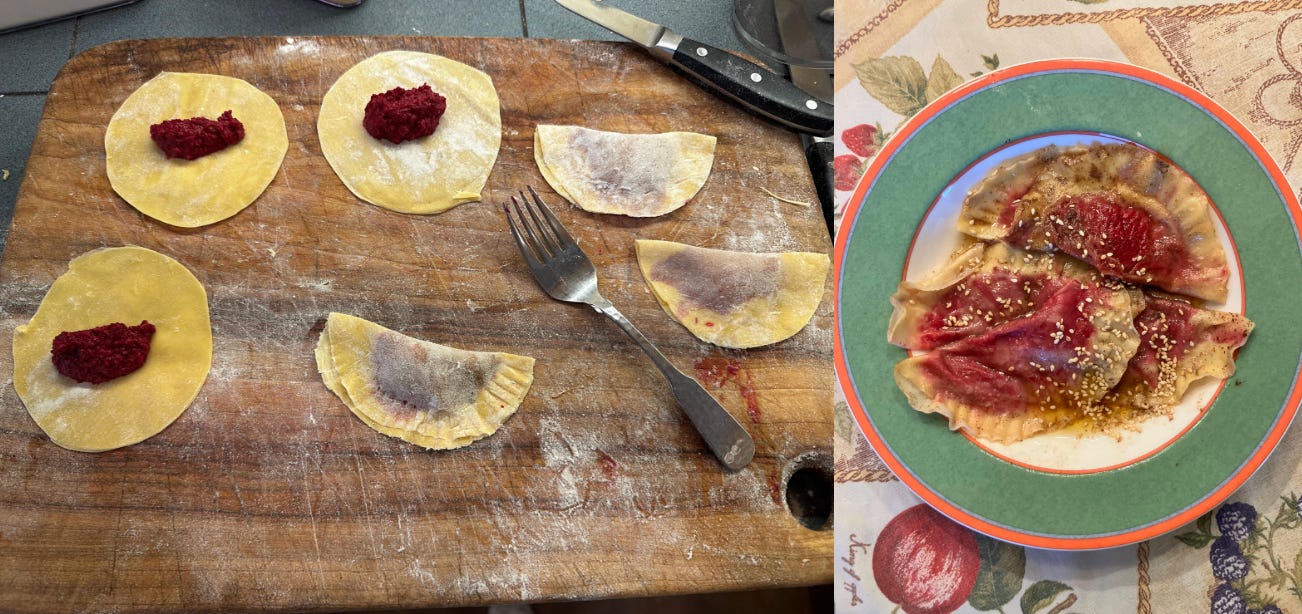
For dinner this week we had a feast of regional dishes. The first course was Casunziei all’Ampezzana — beet-filled ravioli. It was the first time I tried to make my own ravioli. I didn’t have the right sort of ravioli cutter, so I stamped the circles with a coffee grinder lid and cut them out by hand. It was a bit of a challenge transferring them to the serving dish without having them burst open and spill the beet filling, but the one on the right worked out OK:
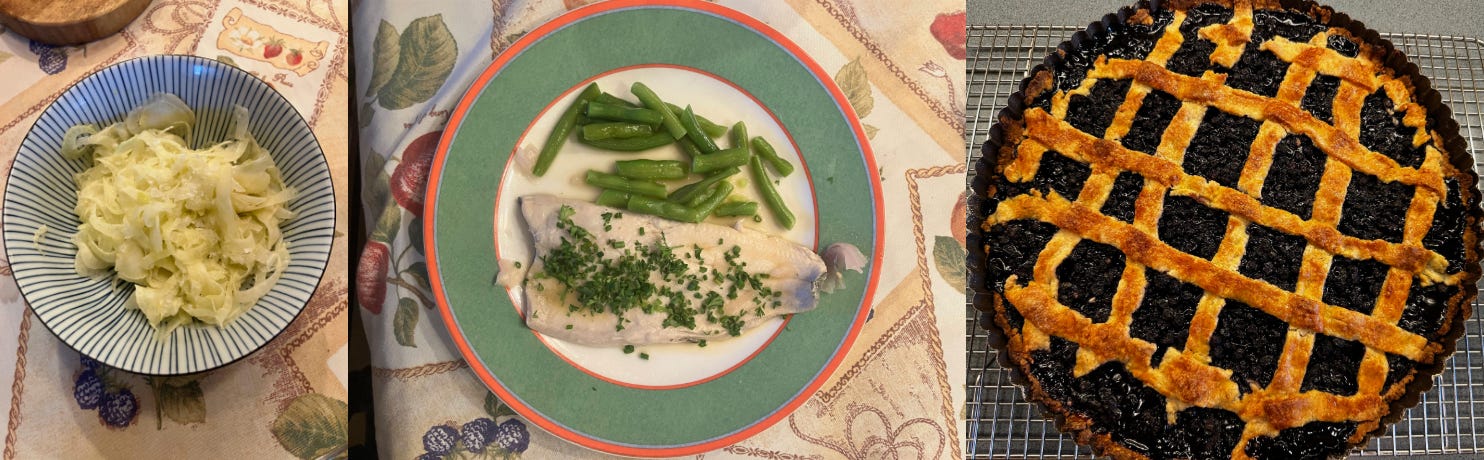
I dressed them with brown butter, sesame seeds, and grated fiore sardo — a hard smoked cheese that was the closest thing I could find to the regional smoked ricotta. It was delicious. We followed with a palate cleanser of shaved fennel dressed with olive oil and lemon juice.
For the second course we caught some trout from the Avisio River a few 100 yards away and poached them in white wine and fish stock, which we reduced to a beurre blanc sauce. For dessert, my wife made a crostata of mirtilli neri — wild bilberries that we gathered from the slopes in the background (aka Wyman’s Maine blueberries):